How do you pick a Legend?
Pick a Riftbound Legend by its champion, its ability and its two domains. Start with a champion you enjoy, read what the Legend's ability rewards, check the cards its domains and champion bring, and learn on a Legend whose ability works without much planning.
- 7 min read
- Updated Oct 13, 2026
In Riftbound: the League of Legends trading card game, the Legend is the first card you choose for a deck, and that choice settles most of what comes after it. The Legend gives the deck its two domains, names the champion whose champion units and signature cards you may play, and has an ability that works from your first turn to your last. Riot's deckbuilding primer calls the Legend the best place to start a deck, ahead of picking a domain.
Where should you start when you choose a Legend?
Start with a champion you enjoy. The Legend is the one card you see in every game with the deck, and its champion comes back in your chosen champion and your signature cards. If you play League of Legends, your favorite champion is a natural place to begin. If you do not, the art or the ability is just as good a reason. The champions page shows each champion with their Legend, champion units and signature cards together.
What does the Legend's ability tell you about the deck?
A Legend's ability is the plan of the deck in one line of text. Read it, ask what it rewards, and fill the deck with cards that do that thing. Four Legends from Origins show how different those plans can be.
- Loose Cannon, the Legend of Jinx, draws you a card at the start of your Beginning Phase when you hold one card or none. A Jinx deck wants cheap cards and a hand that empties fast.
- Herald of the Arcane, the Legend of Viktor, plays a 1 Might Recruit unit token when you pay 1 Energy and exhaust it. A Viktor deck wants a wide board of small units.
- Relentless Storm, the Legend of Volibear, can be exhausted to channel one more rune when you play a Mighty unit, which is a unit with 5 Might or more. A Volibear deck wants big units.
- Nine-Tailed Fox, the Legend of Ahri, gives each enemy unit that attacks one of your battlefields one less Might for the turn. An Ahri deck wants a patient plan that holds battlefields.
 Loose CannonOGN-251/298
 Herald of the ArcaneOGN-265/298
 Relentless StormOGN-249/298
 Nine-Tailed FoxOGN-255/298
How much do the two domains matter?
The domains matter as much as the ability, because every card in the Main Deck and every rune has to fit the Legend's two domains, as the article on the domain rule explains. Look at the cards of both domains before you settle, because each domain has a style of its own: Fury attacks, Calm holds, Mind plans ahead, Body plays big units, Chaos plays tricks and Order fills the board.
Two Legends with the same domains can still ask for different decks. Glorious Executioner, the Legend of Draven, is Fury and Chaos like Loose Cannon, but it draws you a card whenever you win a combat, so a Draven deck wants units that win fights rather than an empty hand. Some pairs of domains offer a wide choice and others almost none: Fury and Chaos has six Legends, one of them from Radiance, with its release on 23 October 2026, while Fury and Calm, Mind and Body, and Chaos and Order have one each. The Legends page has a filter for each domain, so you can compare every Legend of a pair you like.
Which cards come with the Legend's champion?
The champion brings the champion units, one of which becomes your chosen champion, and the signature cards, of which a deck may hold three in all. Most champions have two or three champion units, and they can pull the deck in different directions.
Riot's primer uses Lee Sin as its example. Blind Monk, his Legend, buffs a friendly unit when you pay 1 Energy and exhaust it. Lee Sin, Ascetic can have any number of buffs, so a deck that chooses him pours the buffs into one large unit. Lee Sin, Centered gives other buffed friendly units at his battlefield +2 Might, so a deck that chooses him spreads its buffs across many units. His signature spell Dragon's Rage moves an enemy unit and makes it trade damage with another enemy unit there, which suits either plan.
 Blind MonkOGN-257/298
 Lee Sin, AsceticOGN-078/298
 Lee Sin, CenteredOGN-151/298
 Dragon's Rage, Lee SinOGN-258/298
A banned champion unit narrows the choice, because a banned card cannot be in a Constructed deck at all. On the banned list Riot updated on 18 September 2026, Draven, Vanquisher and Ekko, Recurrent are banned in Constructed, so Draven and Ekko decks choose their chosen champion from their other champion units.
Which Legends are easiest to learn?
A Legend whose ability works on its own, like Loose Cannon or Nine-Tailed Fox, is the easiest to learn, because it helps without asking for a decision. A Legend you exhaust and pay Energy for, like Herald of the Arcane, asks for a choice every turn, and the Energy it costs is Energy you do not spend on cards. Glorious Executioner draws a card each time you win a combat, and Pridestalker, the Legend of Rengar, gives a unit +1 Might for the turn whenever you play a unit. Both Legends pay off in the fights that a new player has anyway.
- Nine-Tailed FoxOGN-255/298
- Loose CannonOGN-251/298
 Glorious ExecutionerSFD-185/221
 PridestalkerUNL-183/219
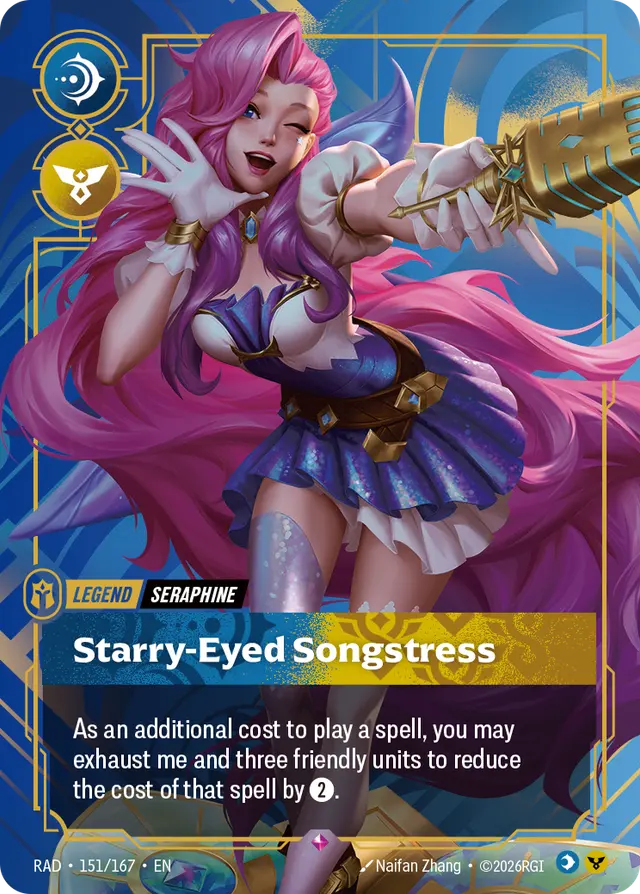
Some Legends ask you to plan several turns ahead, and they suit a second deck better. Virtuoso, the Legend of Jhin, pays off only once four spells are banished with it, and it can banish only spells on which you spent 4 Energy or more. Starry-Eyed Songstress, the Legend of Seraphine from Radiance, with its release on 23 October 2026, makes a spell 2 Energy cheaper only when you exhaust it together with three of your units. Master of Shadows, the Legend of Zed, is Empowered when you banish one of your own cards and has to give that up to use its ability, which takes practice too.


The ready-made decks are another easy way in. Each Champion Deck is built around one Legend, as are the two decks in a Showdown Decks box and the four decks in Proving Grounds, so you can see how a Legend plays before you build around it. Which box is right depends on how many people will learn with you, as the answer to which starter deck a new player should pick shows.
Should you pick the strongest Legend?
Strength is a fair reason to pick a Legend, but a poor first one. Which Legends are strongest can change with every set and every update of the banned list, while a champion you enjoy stays enjoyable. Once you want a deck for competitive play, read up on the strongest Legends and the current meta.
The banned list of 18 September 2026 bans no Legend in Constructed, but it bans Wuju Bladesman, a Legend of Master Yi, in two-versus-two Constructed. In Magma Chamber, the two-versus-two mode, two teammates may not play the same Legend (Core Rules 491.8.h).
Can you change your Legend once you have chosen it?
Outside a tournament you can change it whenever you like, although a new Legend usually means a new deck. At a Constructed tournament you keep one Legend for the whole event: the decklist you register records it, and the Tournament Rules do not let you change it after registration, not even when you sideboard between games (rules 401.2, 401.3 and 403.4.b on Riot's Rules Hub). A casual Constructed event that asks for no decklist still expects you to play the same deck throughout, unless the organizer allows a change (rule 401.1.b).
Sealed and Draft work differently, since you can only pick a Legend you opened or drafted at the event. There a deck may change its Legend between games while sideboarding, or go without one (Tournament Rules 602.4.a.5 and 602.4.a.7.a for Sealed, 602.4.b.6 and 602.4.b.8.a for Draft).
Every Legend is on the Legends page, and the shared decks can be filtered by Legend to show what other players have built around one. The deck builder keeps the rest of the deck within the Legend's domains. Once the Legend is chosen, the next choice is how cheap or costly the cards around it should be, which a good Energy curve answers, and building your first Riftbound deck shows a whole deck from the Legend to the 12 runes.