How does the Calm domain play?
Calm is the green domain of Riftbound, and it plays a patient, defensive game. A Calm deck takes a battlefield and keeps it with Shield, Tank, stuns, counterspells and spells that move enemy units away, and it aims to win by holding battlefields.
- 7 min read
- Updated Oct 13, 2026
Calm is one of the six domains of Riftbound: the League of Legends trading card game. It is the green domain, and its symbol on a card looks like a leaf. In its Deckbuilding Primer, Riot Games describes Calm as being about "balance, meditation, and the peace of holding". A Calm deck does not race to conquer. It takes a battlefield, makes it hard to attack, and lets the points come in turn after turn.
Every Legend has two domains, so a Calm deck always plays Calm together with a second domain, and that second domain changes how it plays.
What does a Calm deck try to do?
A Calm deck tries to win by holding battlefields. You score one point for each battlefield you still control at the start of your turn, and the final point rule does not limit points from holding, so holding is the surest way to the last point of a game. Riot's primer says Calm decks use defensive tricks, moving enemies and answers such as counterspells and stuns to defend their holds.
Many Calm units have an ability that starts with "When I hold". In the main sets before Radiance, the fifth set, with its release on 23 October 2026, Calm has more cards that care about holding than any other domain.
- Ahri, Alluring scores you one more point when she holds, so the battlefield she stands on is worth two points at the start of your turn.
- Vilemaw draws you a card when it holds.
- Tianna Crownguard stops your opponents from gaining any points at all while she is at a battlefield.


How do Calm cards protect a battlefield?
Calm makes its units hard to beat on defense. Shield gives a unit extra Might while it is a defender, and Tank means an attacker must assign lethal damage to that unit before your units without Tank. In the main sets before Radiance, Calm has more cards with Shield than any other domain.
Sunlit Guardian has 3 Might with Shield and Tank, so it defends with 4 Might and takes an attacker's damage first. Taric, Protector gives Shield to your other units at his battlefield as well. Calm also wins fights with tricks: Discipline has Reaction, so you can play it during your opponent's attack to give a unit +2 Might and draw a card. Navori Scout has Deflect, so an opponent must pay one more Power to choose it with a spell or ability.


How does Calm stop the opponent's plays?
Calm answers threats mostly without destroying them. It has three tools for this, and in the main sets before Radiance it has more counterspells and more stuns than any other domain.
- Counterspells. A counterspell cancels a spell before it resolves, and the player who played it does not get back what they paid. Wind Wall counters any spell for 3 Energy and 2 Power, and Hush, a Radiance card, counters a spell whose Power cost is 2 or more.
- Stuns. A stunned unit deals no combat damage for the rest of the turn. Rune Prison stuns any unit, and Thwonk! stuns an attacking unit, which takes that unit's damage out of an attack on your battlefield.
- Moving enemies. Charm moves an enemy unit, so on your turn you can send a lone defender away and take its battlefield without a fight. Janna, Savior can be played as a Reaction to a battlefield you control, and she sends one enemy unit there back to its base.
 Wind WallOGN-064/298
 Rune PrisonOGN-050/298
 Thwonk!SFD-040/221
 CharmOGN-043/298
 Janna, SaviorSFD-053/221
Where is Calm weak?
Calm struggles when it has to attack. Riot's primer says Calm cards have a harder time being very aggressive or interacting with the opponent without using their units, and the cards bear that out. In the main sets before Radiance, only one Calm card, Tasty Faefolk, has Accelerate, and no spell that is Calm alone deals damage to a unit or kills one. The few that do, such as Ahri's signature spell Fox-Fire, share a second domain.
When Calm removes a unit, it usually does so through a unit of its own. Yasuo, Remorseful deals damage equal to his Might to an enemy unit at his battlefield when he attacks, and Caitlyn, Patrolling can be exhausted while she is at a battlefield to deal damage equal to her Might to a unit at any battlefield. An opponent who kills those units takes Calm's removal away with them, so the second domain of a Calm deck often brings the damage.
Which Legends lead Calm decks?
Origins, Spiritforged, Unleashed and Vendetta each brought three or four Calm Legends, and Radiance, with its release on 23 October 2026, has three more. Origins paired Calm with Mind, Body, Chaos and Order, and Vendetta added the first Legend in Fury and Calm.
- Nine-Tailed Fox (Ahri, Calm and Mind) gives every enemy unit that attacks one of your battlefields one less Might for the turn, which makes each of your holds harder to break.
- Radiant Dawn (Leona, Calm and Order) buffs one of your units whenever you stun enemy units, so it rewards a deck full of stuns.
- Rogue Assassin (Akali, Fury and Calm) can pull one of your units out of a showdown on your turn and send it back to base, and once it is Empowered it readies that unit too.
- Pride of Nazumah (K'Sante, Calm and Body), from Radiance, gives one of your units Assault equal to its Shield for the turn, so a Calm defender can attack just as hard.
 Nine-Tailed FoxOGN-255/298
 Radiant DawnOGN-261/298
 Rogue AssassinVEN-139/166
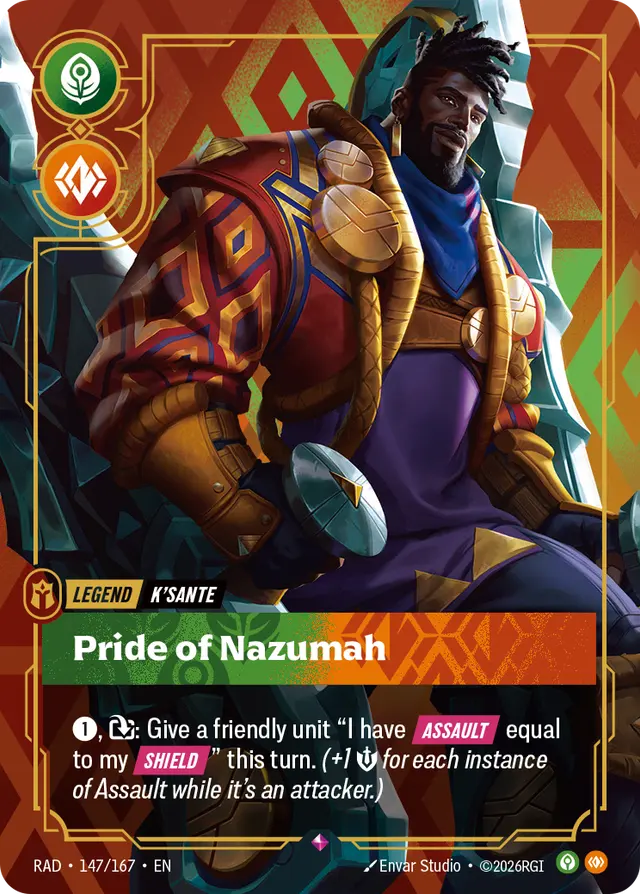 Pride of NazumahRAD-147/167
Vendetta also set Calm and Fury against each other: Decree of Rage is a Fury spell that cannot be countered and deals 4 to an enemy Calm unit.
How has Calm changed from set to set?
Each set after Origins gives Calm a new theme on top of its defensive core.
- Spiritforged brought Equipment, such as Doran's Shield, which you attach to a unit.
- Unleashed brought XP: Herald of Spring gains XP when it conquers or holds, and Master Yi, Unstoppable gets cheaper as your Level rises.
- Vendetta brought Empower, and several of its Calm cards reward you for controlling seven or more runes. Esteemed Hierophant takes no damage from enemy spells and abilities once you do.
- Radiance, the fifth set, with its release on 23 October 2026, brings gear with Deploy that is played straight to a battlefield, such as Blossoming Dreamroot.
Is Calm a good domain for a new player?
Calm suits a patient player, with one catch. Its units are easy to play, because Shield and Tank work without any decisions. Its spells ask more of you: a counterspell or a stun is only as good as the moment you choose for it, and you have to keep runes unused on your own turn to pay for it on your opponent's.
A ready-made deck is a good way to try the domain. The Origins Champion Deck: Lee Sin is Calm and Body and the Unleashed Champion Deck: Vex is Calm and Chaos, each with a launch price of $19.99. Today the Lee Sin deck sells for $46.99 and the Vex deck for $21.16. The Master Yi deck in the Proving Grounds box is Calm and Body as well. Single Calm cards come from local game stores and from online marketplaces: Cardmarket in Europe, TCGplayer in the United States and CardTrader on both sides of the Atlantic.
Every Calm card is in the card list, which you can filter by domain, and the Legends page shows every Calm Legend. Fury plays the opposite way, taking battlefields early and scoring fast where Calm waits and holds, as the Fury domain shows. Because a Legend sets the second domain of the deck, choosing among the Calm Legends mostly means choosing what Calm should be paired with, which the guide to picking a Legend takes step by step.
Prices marked with a dot are live market prices.