What do you need for a game of Riftbound?
Each player needs a Riftbound deck of their own: a Champion Legend, a Main Deck of at least 40 cards with the chosen champion, 12 runes and three battlefields. Add a table, a way to count points and damage, and something to stand in for tokens. Sleeves and a playmat help, but a game at home needs neither.
- 8 min read
- Updated Oct 13, 2026
A game of Riftbound: the League of Legends trading card game needs two players, a deck for each of them and a table to play on. Apart from the cards, the game asks only for a few small objects to keep count with, and coins, dice or spare cards do that job well. Sleeves, a playmat and a deck box make a game more comfortable, but a game at home needs none of them.
This article covers the Duel, the standard game for two players. The modes for three and four players need the same things for every player at the table, as the last part explains.
What does each player have to bring?
Each player has to bring a complete deck of their own. The Core Rules say that every player provides their own cards, and they count four parts as a player's deck.
- One Champion Legend. The Legend starts the game in play and sets the two domains that every other card in the deck has to fit.
- A Main Deck of at least 40 cards. The Main Deck holds the units, spells and gear you play. It may hold at most three cards with the same name. One of its cards is the chosen champion, a champion unit that starts the game face up beside the Legend and counts as one of the three copies of its name.
- A Rune Deck of exactly 12 runes. The runes are shuffled apart from the Main Deck and pay for your cards during the game.
- Three battlefields with different names. In a Duel each player picks one of their three battlefields at random before the game, so two battlefields are in play.
| Part of the deck | Cards |
|---|---|
| Champion Legend | 1 |
| Main Deck, chosen champion included | 40 or more |
| Rune Deck | 12 |
| Battlefields | 3 |
| Smallest complete deck | 56 |
The Spiritforged Champion Deck: Fiora shows a complete deck card by card, as Riot published its list. Its 56 cards fill the four parts exactly.
- Champion Legend: Grand Duelist, the Legend of Fiora, in the domains Body and Order.
- Chosen champion: one of the deck's Fiora units, picked by the player, either Fiora, Peerless or Fiora, Worthy. The deck holds two copies of Fiora, Peerless, so a player who picks it starts with one copy beside the Legend and keeps the other in the Main Deck.
- Units, 20 cards: two each of Fiora, Peerless, Jaull-Fish, Laurent Duelist, Lucian, Merciless, Veteran Poro, Pit Rookie, Dauntless Vanguard, Unsung Hero and Royal Guard, and one each of Fiora, Worthy and Yone, Blademaster.
- Spells, 10 cards: three Strike Down, two each of Punch First, Vengeance and Show of Strength, and one Riposte, a signature spell of Fiora.
- Gear, 10 cards: three each of B.F. Sword, Doran's Blade and Warmog's Armor, and one Sacred Shears.
- Rune Deck, 12 cards: six Body Runes and six Order Runes.
- Battlefields, 3 cards: Ornn's Forge, Sunken Temple and Veiled Temple.
 Grand DuelistSFD-205/221
 Fiora, PeerlessSFD-110/221
 Fiora, WorthySFD-180/221
 B.F. SwordSFD-161/221
 Strike DownSFD-107/221
 Ornn's ForgeSFD-213/221
The deck keeps to every limit of the four parts. No name appears more than three times, every card in the Main Deck and the Rune Deck belongs to Body, Order or both, and the three battlefields have different names.
Is a ready-made deck enough to play?
Yes. A ready-made deck holds every part a game needs, so two players with one ready-made deck each can start right away. Three kinds of ready-made product suit a first game.
- A Champion Deck is one deck of 56 cards built around one champion, complete by the full rules. It comes with a booster pack, a full-size paper playmat, a foldable paper deck box and a rules and deck-building booklet. Two players need two Champion Decks.
- A Showdown Decks box holds two decks of 56 cards made to play against each other, with two booster packs and two paper playmats. Vendetta had Zed against Shen, and the box of Radiance, with its release on 23 October 2026, has Evelynn against Seraphine.
- Proving Grounds holds four decks of 54 cards for two to four players. Each deck brings one battlefield instead of three, which is enough inside the box, so a player who takes one of its decks to other games needs two more battlefields.
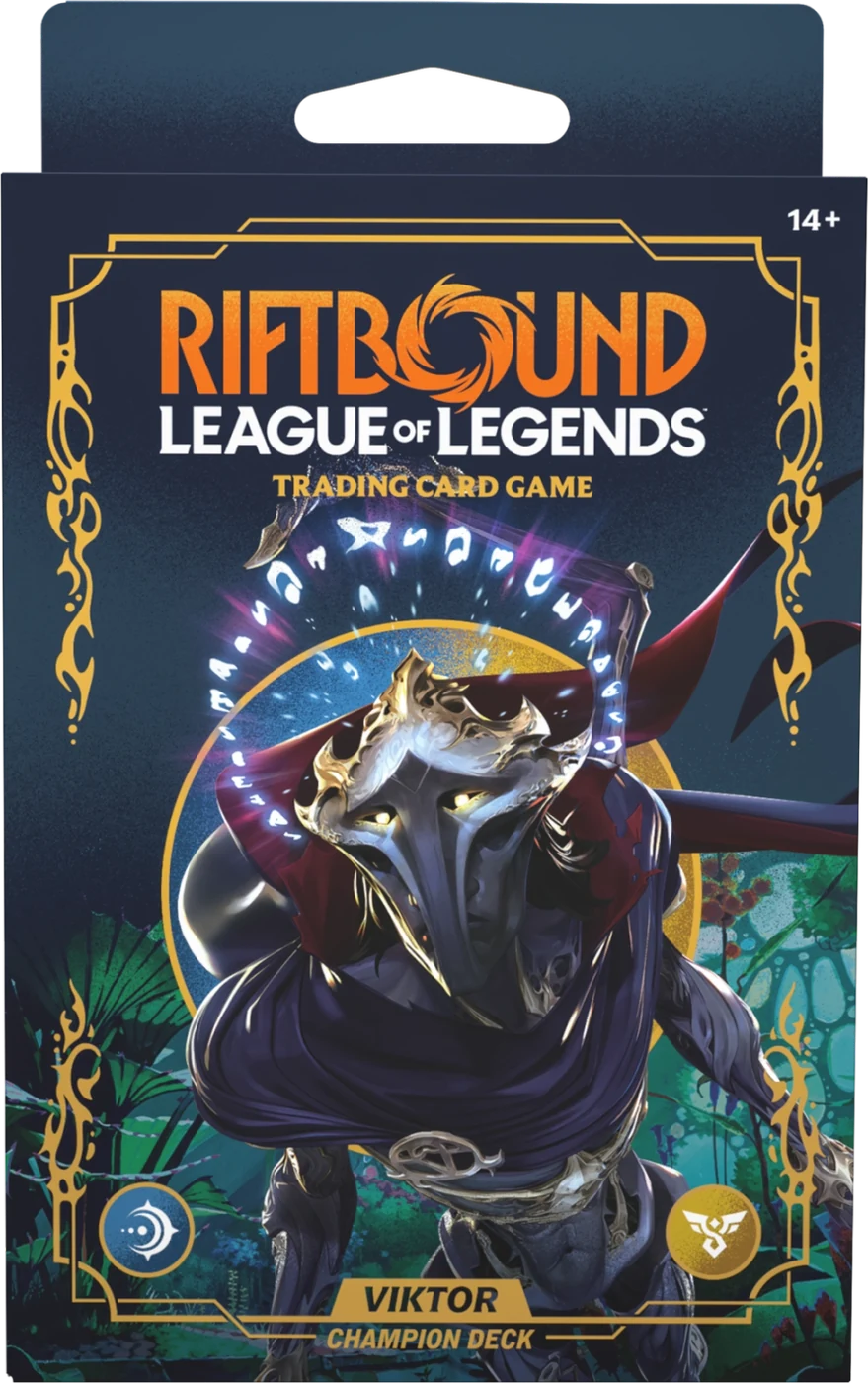
The products guide shows the ready-made decks with their cards, and the article on how much it costs to start compares their launch prices.
The quickest way by far to learn Riftbound is to have a friend or someone you know who already plays teach you during a real first game, explaining each step as you go. The rules then come up in the order the game needs them, with the cards on the table as examples. A player with nobody to teach them can still start from a short guide, as the article on the quickest way to learn the rules explains.
What else goes on the table besides the cards?
A game also needs a way to keep track of a few things that no card shows, and none of them asks for anything special.
- The score. Both players keep count of both scores, from 0 up to the 8 points that win a Duel. A die, a notepad or a phone works well at home.
- Damage. Damage stays on a unit only until the end of the turn, and the Core Rules allow coins, dice, other markers or simply memory to track it.
- Tokens. Some cards create units or gear that are not in any deck, which are called tokens. The Core Rules let anything stand in for a token, and at Competitive and Professional events a token has to be a card that can be turned sideways to show it is exhausted.
- Buffs and XP. A buff is a marker that gives a unit +1 Might, and XP is a number each player collects with cards from Unleashed, the set that brought it. A coin, a die or a spare card keeps track of either.
- A coin or a die. The Core Rules let the players decide who goes first in any fair random way they agree on.
The Fiora deck shows why these pieces matter. Royal Guard plays a 2 Might Sand Soldier unit token when you play it, and Pit Rookie gives another friendly unit a buff, so a player with that deck wants a few coins or spare cards within reach. The box of the deck holds five Sand Soldier token cards.
Riot also prints cards for these pieces, such as the Recruit, Sprite and Gold tokens and the Buff and XP Tracker cards below, and one card in every booster pack is a rune or a token.


How much room does a game take?
A Duel needs a table with the battlefields in the middle and a strip of space in front of each player. That strip holds the player's base, where runes, gear and the units not at a battlefield stand, the Legend and the chosen champion, the Main Deck with the trash beside it, and the Rune Deck. Each of these spaces is a zone of the Riftbound play area with rules of its own. Cards turn sideways when they are exhausted, so leave room for runes and units lying on their side.
Do you need sleeves or a playmat?
No. The Core Rules ask for neither sleeves nor a playmat, so a game at home can be played on a bare table with cards straight from the box. Both still help. A playmat gives every card a fixed place: Champion Decks and Showdown Decks come with paper ones, and the official neoprene playmats of Spiritforged and Unleashed measure 24 by 14 inches (61 by 35.6 centimeters). Sleeves keep cards safe while they are shuffled, and the official art sleeves come in packs of 100, enough for one full deck.
At a tournament, the Tournament Rules say that every sleeve in a deck has to be identical and have an opaque back. At Competitive and Professional events, the higher levels of organized play, sleeves are required on the Main Deck, the Rune Deck and the battlefields.
What changes with more players or at a store event?
A game for three or four players needs the same things for every player: a deck with three battlefields, a seat at the table and a way to keep every score. Skirmish for three players and War for four are played to 8 points, and Magma Chamber, for two teams of two, is played to 11 points with one score per team.
A Riftbound event in a store adds a few rules of its own, and the article on what to bring to your first event lists everything to pack. Every card has to be a real Riftbound card, because the Tournament Rules allow no proxies at an event of any level. At Competitive and Professional events the score has to be kept in writing, while dice or a phone are enough at casual events.
Once both decks are on the table, the article on setting up a game takes you from shuffling to the first turn. The cards for a deck of your own come from booster packs, or as single cards from local game stores, Cardmarket in Europe, TCGplayer in the United States and CardTrader on both sides of the ocean. The deck builder checks the four parts while you build, and the tokens page shows many of the printed tokens.