What do set codes and abbreviations like OGN and SFD stand for?
OGN, SFD and the other three-letter codes are Riot's short names for the Riftbound sets: OGN is Origins, OGS the Proving Grounds cards, SFD Spiritforged, UNL Unleashed, VEN Vendetta and RAD Radiance. Every card prints the code of its set before its number.
- 6 min read
- Updated Oct 13, 2026
Riftbound: the League of Legends trading card game has a short form for nearly everything. Card lists name a card by its set code and number, such as OGN 251 for Loose Cannon, store events are listed as 1v1 or Bo3, and the Tournament Rules write OPL and CR. The short forms you will meet most often are the set codes: Riot gives every set a three-letter code, and every card prints the code of its set.
Which set does each code stand for?
Each set has a three-letter code, and for the main sets the letters come from the name of the set: OGN from Origins, SFD from Spiritforged. The list gives the six set codes in use so far, in the order the sets came out.
- OGN is Origins, the first set, released in English on 31 October 2025.
- OGS is the group of 24 cards made for the Proving Grounds starter box, which came out together with Origins.
- SFD is Spiritforged, the second set, released in English on 13 February 2026.
- UNL is Unleashed, the third set, released in English on 8 May 2026.
- VEN is Vendetta, the fourth set, released on 31 July 2026.
- RAD is Radiance, the fifth set, with its release on 23 October 2026.
The Tournament Rules use the same codes in their list of the sets that are legal in Standard (rule 601.3.c), where the Proving Grounds cards are called the Origins supplemental set contained in Proving Grounds. Many cards in the four Proving Grounds decks are Origins cards and carry OGN. Only the 24 cards made for the box carry OGS, such as Dark Child, the Legend of Annie.
The row below shows one Legend for each code, in the order of the list: Loose Cannon, Dark Child, Grand Duelist, Wuju Master, Rogue Assassin and Starry-Eyed Songstress.
 Loose CannonOGN-251/298
 Dark Child, StarterOGS-017/024
 Grand DuelistSFD-205/221
 Wuju MasterUNL-191/219
 Rogue AssassinVEN-139/166
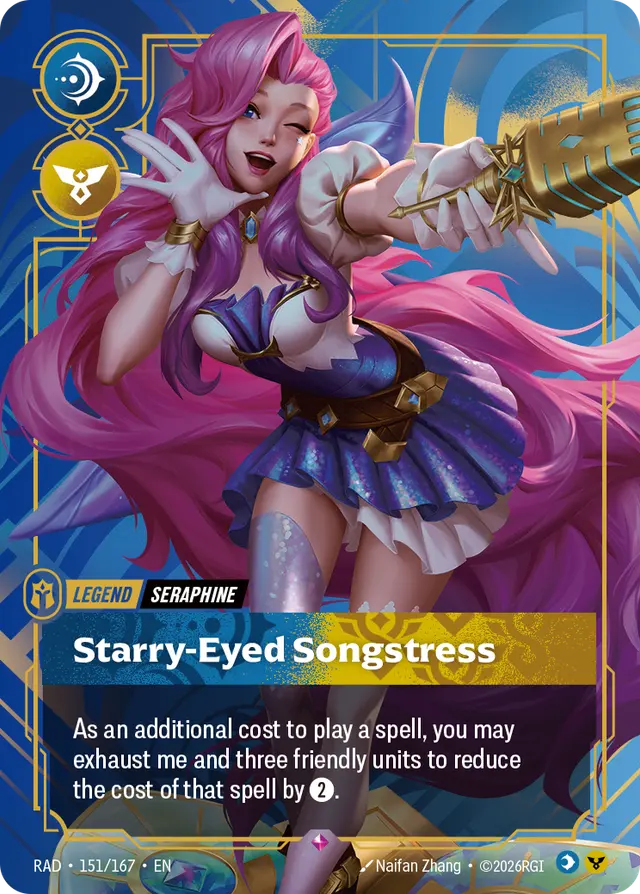 Starry-Eyed SongstressRAD-151/167
Which codes have the next releases been given?
Riot gave the codes of its 2027 releases in its overview of products and sets of 3 August 2026.
- LGC is Legacy, the sixth set, with a release date of 29 January 2027.
- PG2 is Proving Grounds, 2nd Edition, the second edition of the Proving Grounds starter box, dated 19 February 2027. It is the only code in this list with a digit in it.
- REC is The Reckoning, the seventh set, dated 30 April 2027.
That overview gave no codes for the eighth and ninth sets, which Riot plans for the third and fourth quarters of 2027. Riot's hashtags for the sets, such as #RBRadiance and #RBLegacy, use the name of the set and not its code.
Where is the set code printed on a card?
The set code sits at the left end of the line along the bottom edge of every card, before the collector number. Jinx, Demolitionist reads OGN · 030/298, which means card 30 of the 298 numbered cards of Origins. Cards from Vendetta on add a language code at the end of that line, so Rogue Assassin reads VEN · 139/166 · EN, with EN for English. The regular cards of the earlier sets end after the number.
Riot uses the same kind of two-letter codes for the languages of its editions when it announces a product: EN for English, CN for Chinese, FR for French and KR for Korean.
Letters beside the number mark other printings and cards numbered apart from the set: a for alternate art, a star for a signed printing, SP for a special card, T for a token and R for a basic rune of the later sets. The newer promos also print a P after the number, as Mel, Newly Awakened does at VEN · 069b/166 · P · EN, while the Origins Nexus Night promos print none. The three cards of the Secret Garden Bundle carry a code of their own, SGN, such as Bashful Bloom at SGN · 001/003 · P · EN.
What do OPL, CO and CR mean in the rule books?
OPL, CO and CR come from the Tournament Rules, the rule book for events, which uses them throughout.
- OPL is the Organized Play Level, which sets how strictly an event treats mistakes against the rules (rule 205). There are three levels: Casual, the level of most events, and Competitive and Professional above it. The rules call Casual low OPL and the other two high OPL. Summoner Skirmish events, for example, are played at Competitive.
- CO is the Competition Organizer, who registers an event with Riot or its partners and provides the venue (rule 204.3).
- CR is the Core Rules, the rule book of the game itself. The Tournament Rules point to it with references such as CR 101 for the rules of deck construction.
The Core Rules have short forms of their own. The game modes are headed 1v1 for the Duel and the Match, FFA3 for Skirmish, FFA4 for War and 2v2 for Magma Chamber (rules 487 to 491). FFA stands for free-for-all, a game in which every player plays for themselves, with no teams. In the rules on the Chain, HOT FEPR is the short name for what the game does after a player takes an action that leaves tasks to handle: Handle Outstanding Tasks, then Finalize, Execute, Pass and Resolve the pending items on the Chain (rule 334).
Which short forms come up at events and in stores?
These short forms turn up in event listings and in announcements about events and products.
- Bo1 and Bo3 mean best of one and best of three. A Duel is a single game, while a Match goes to the first player to win two games, and some store events name one or the other in their title.
- RQ is a Regional Qualifier, as in RQ Los Angeles in September 2026. Riot announced on 4 August 2026 that Regional Qualifiers become Riftbound Regionals in 2027.
- OP is organized play, the program of official events that runs from the weekly Nexus Night to Summoner Skirmish and beyond.
- LGS is a local game store, the kind of store where Nexus Night and other store events are held.
- RGN is the Riftbound Gaming Network, the platform where stores register and schedule their official events.
- TCG is trading card game, and LoL is League of Legends, the game the champions come from.
- MSRP is the manufacturer's suggested retail price. This guide calls it the launch price: a booster pack launched at $4.99.
Each of the six set codes has a page of its own in the card list, from Origins and Proving Grounds to Radiance, and the promo cards page gathers the promos. The words of the game itself, such as Legend, showdown and the Chain, are explained in the most common Riftbound terms, and what each set added to the game is in which Riftbound sets there are.