How much does it cost to start playing Riftbound?
Riftbound can be started with one Champion Deck, a complete deck ready to play with a launch price of $19.99. Two players can share a Showdown box, launched at $34.99, or Proving Grounds, reprinted in 2026 at $39.99, and a weekly Nexus Night at a store most often costs 5 to 10 dollars or euros.
- 9 min read
- Updated Oct 13, 2026
Riftbound: the League of Legends trading card game costs less to start than many people expect. One ready-made deck is enough for a single player, one box with two or four decks is enough for two people who learn together, and the official rules are free to read online. What you spend after that depends on how you want to play: at home with friends, at the weekly event of a local store or at tournaments with a deck of your own.
The prices written as numbers in this article are launch prices, the prices in US dollars that Riot set when each product came out. The prices marked with a dot are market prices of the moment, in dollars or euros. A product that has sold out can cost more, as the article on why products sell above their launch price explains.
What is the cheapest way to start playing Riftbound?
The cheapest way to start is a Champion Deck, which has a launch price of $19.99. Once a deck has been out for a while its price follows the market: the Jinx deck of Origins sells for $33.02 today, and the Vi deck of Unleashed for $15.60. A Champion Deck is one complete deck of 56 cards built around one champion: a Legend, a main deck of 40 cards, a rune deck of 12 runes and three battlefields. It comes with a booster pack of its set, a full-size paper playmat, a deck box and a rules booklet.
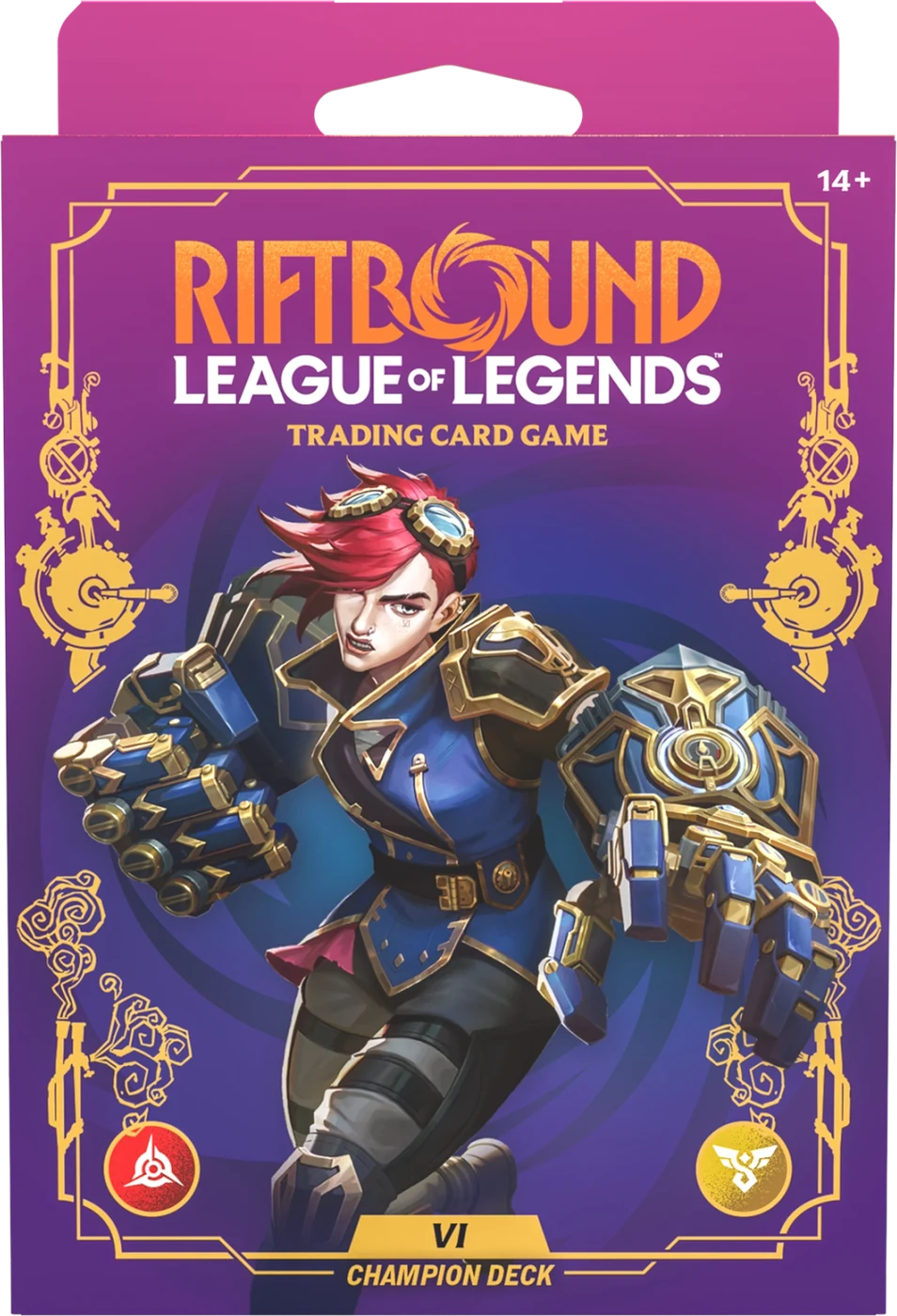
A Champion Deck follows the full deck rules, so it can go to a store event the day it is opened. At casual events such as Nexus Night, a ready-made deck played exactly as it comes in its box may even keep cards that have been banned since. Legacy, the set with its release on 29 January 2027, brings Champion Decks for Tryndamere, Ashe, Lux and Garen, and Riot has not announced their price.
Trying the game first can cost nothing at all. The quickest way by far to learn Riftbound is to have a friend or someone you know who plays teach you during a real first game, explaining each step as you go, and with their decks it costs you nothing. Most Learn to Play events at stores are free as well, and the store lends you a deck. The Core Rules and the Tournament Rules are free to read on Riot's Rules Hub.
How much does it cost for two players to start together?
Two players who learn together pay the least per deck with a box that holds more than one deck. Showdown boxes and the Proving Grounds box are made for this, and the table compares their decks with a Champion Deck.
| Product | Decks | Launch price | Per deck | Today |
|---|---|---|---|---|
| Champion Deck (Vi, Unleashed) | 1 | $19.99 | $19.99 | $15.60 |
| Showdown box (Vendetta) | 2 | $34.99 | $17.50 | $15.14 |
| Proving Grounds, first printing | 4 | $29.99 | $7.50 | $53.13 |
| Proving Grounds, reprint of 2026 | 4 | $39.99 | $10.00 |
A Showdown box holds two complete decks of 56 cards made to play against each other, with two booster packs, two paper playmats and two deck boxes. Vendetta had Zed against Shen, and Radiance has Seraphine against Evelynn, with its release on 23 October 2026. Proving Grounds is the starter box for two to four players, with decks built around Annie, Garen, Lux and Master Yi and four acrylic champion figures to keep score with.
At launch prices, Proving Grounds gives the cheapest deck per player, with one catch. Each of its decks holds one battlefield, while a deck by the full rules brings three, so a Proving Grounds deck needs two more battlefields before it goes to a store event. A second edition with four new decks follows on 19 February 2027, and Riot has announced it at $40.
Do you need booster packs to start?
No, a new player needs no booster packs to start. A booster pack holds 14 random cards from one set. A booster display of 24 packs has a launch price of $119.99, which comes to about $5 a pack, and the Vendetta display sells for $139.71 today. Packs are the way to add cards to a deck that already works, or to collect, but random cards from one set rarely make a deck on their own.
Packs are also a slow way to find one particular card. An Origins display holds about six Epics, spread over the 42 different Epics of the set, so it holds one particular Epic only about one time in seven. A player who needs three copies of one card usually gets there sooner with single cards, as the article on boosters or single cards explains.
For a player who starts to build decks, the Vault is worth a look. It has a launch price of $34.99 and holds six booster packs, a full set of 36 basic runes with six of each domain, and a storage box. Every deck needs a rune deck of 12 runes, and a booster pack holds at most one rune, in the last slot that it shares with tokens.
What does it cost to play at a store?
Each store sets its own entry fees. For a Nexus Night, the weekly event of a store, most stores ask between 5 and 10 US dollars or euros, and about one Nexus Night in six is free. Every player should get a Nexus Night promo pack for taking part, while the store's supply lasts.
A Pre-Rift event, held in the week before a set releases, costs more because the fee covers the cards you play with. Most stores ask between 30 and 40 dollars or euros. Every player opens a kit with a small ready-made deck, five booster packs of the new set and a promo card, and builds a deck from it at the table.
Signing up for an event needs a Riot account, which is free, and the fee is paid to the store. The event finder shows the entry fee of each event near you, and the article on where to play with other people describes each kind of event.
Which accessories do you need, and what do they cost?
For the first games you need nothing beyond the box, since the ready-made decks come with paper playmats, deck boxes or figures to keep score with. The rest is optional at home and at casual store events.
- Sleeves. Plastic sleeves protect the cards while you shuffle. At casual events such as Nexus Night they are optional unless the head judge asks for them. At Competitive and Professional events, the main deck, the rune deck and the battlefields must be sleeved. The art sleeves that Riot made for Unleashed come 100 to a pack, enough for one deck, with a launch price of $16.99.
- A playmat. A neoprene playmat lasts longer than the paper ones in the boxes. The playmats that Riot made for Unleashed launched at $27.99.
- Something to keep score with. At casual events a die or a phone is enough to track the score. Competitive events ask for the score in writing.
Home-made stand-ins for cards you do not own, called proxies, are not allowed at Riftbound events of any level. Every card in a deck you bring to an event has to be a real card.
How much does a deck of your own cost?
A deck you build yourself has no fixed price, because it depends on the Legend and on a handful of cards. Most of the cards in any deck are Commons and Uncommons, which fill most of every booster pack: a Common such as Pit Rookie sells for $0.17 today. The price of a strong deck sits in a few Epics and Rares.
A casual deck, for games with friends and at Nexus Night, often starts as a Champion Deck. The Vi deck of Unleashed sells for $15.60 today, and its 56 cards come to $12.93 as single cards at market. Most players then upgrade such a deck a few cards at a time, which adds only the price of the cards they swap in.
A deck built to win tournaments puts its money into a few cards. The deck that won the last Regional Qualifier of 2026, in Los Angeles, is led by Pridestalker, the Rengar Legend, and half of its 40 main deck cards are Commons and Uncommons, as Riot's report on the top decks of Los Angeles shows. Most of its value sits in ten cards. It plays three copies of Kai'Sa, Survivor, which sells for $66.24 a copy today, and three of Sabotage at $13.31 each. Its chosen champion, Rengar, Trophy Hunter, sells for $29.23, each of its two copies of the signature spell Thrill of the Hunt for $8.11, and its one Pyke, Dockside Butcher for $15.17.
 PridestalkerUNL-183/219
 Kai'Sa, SurvivorOGN-039/298
 SabotageOGN-156/298
 Rengar, Trophy HunterUNL-120/219
 Thrill of the HuntUNL-184/219
 Pyke, Dockside ButcherUNL-028/219
A card costs a lot when many players want it and few copies of it come out of booster packs. Kai'Sa, Survivor is both: it is an Epic, and it is a Fury unit that any deck with Fury may play, as this Rengar deck does, so players of many Legends want it at once.
Single cards come from local game stores and from online marketplaces: Cardmarket in Europe, TCGplayer in the United States and CardTrader on both sides of the Atlantic. The page of every shared deck on the decks page shows what its cards are worth and, with your cards in your collection, what the cards you still lack would cost. Getting the expensive cards last, once you know the deck needs them, keeps the cost down, as the article on building a strong deck on a budget explains.
What does a typical start cost?
Most new players fall into one of three groups, and each has a clear first step.
- One player who wants to play at a store needs a Champion Deck and the fee of a Nexus Night, or nothing at all at a free Learn to Play event.
- Two players who learn at home need one Showdown box or one Proving Grounds box, which sells for $53.13 today.
- A player who wants to build decks does well with a Vault for the runes and a few packs, such as the Vendetta Vault at $47.84 today, and single cards for the deck they have in mind.
The products guide shows every product with its launch price and what is inside it. The article on which product to get first helps you choose, and the article on how to start playing takes you from the first box to your first event.
Prices marked with a dot are live market prices.