How do you start playing Riftbound?
To start playing Riftbound, get a ready-made deck such as Proving Grounds, a Champion Deck or a Showdown box. Learn by playing a first game with a friend who already plays and explains each step, or from the booklet inside, then join a Learn to Play event or a weekly Nexus Night at a local store.
- 8 min read
- Updated Oct 13, 2026
Starting Riftbound: the League of Legends trading card game takes less than it may seem. You do not need a collection or a tournament deck. You need one ready-made deck for each player, the rules booklet that comes with it and someone to play against, and the quickest start of all is a first game against someone who already plays. Booster packs, decks of your own and tournaments can all come later, and the steps below follow the order most new players take.
What should a new player get first?
A new player should get a ready-made deck, not booster packs. A ready-made deck is built around one Legend, holds every card a game needs and can be played the moment it is opened. A booster pack holds 14 random cards from one set, which rarely fit together and never make a deck on their own. Three kinds of ready-made product suit a beginner.
- Proving Grounds is the starter box for two to four players. It holds four decks built around Annie, Garen, Lux and Master Yi, a How to Play booklet and acrylic figures of the four champions to keep score with. Apart from the Legend, the runes and the battlefield, its decks hold only units and spells, which keeps the first games simple.
- A Champion Deck is one complete deck of 56 cards built around one champion, with a booster pack, a paper playmat and a rules booklet. Origins, Spiritforged and Unleashed each had Champion Decks, among them Jinx, Fiora and Vi.
- A Showdown box holds two complete decks of 56 cards made to play against each other, with two booster packs and two paper playmats. Vendetta had Zed against Shen. The Radiance box, with its release on 23 October 2026, sets Seraphine against Evelynn.
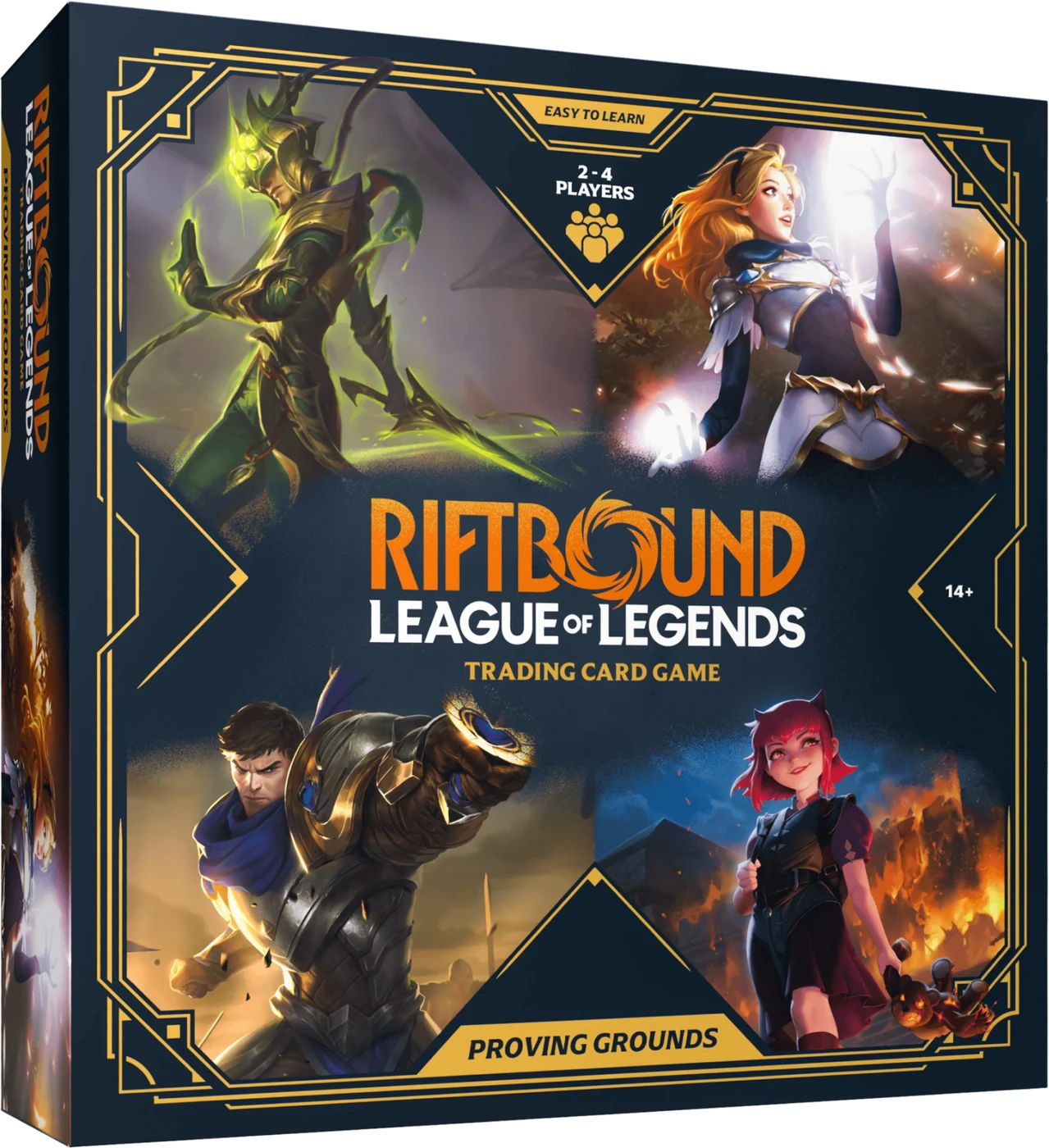
Which one suits you depends on who you will play with. Two people who learn together get the most out of Proving Grounds or a Showdown box, because one box gives both of them a deck. A player who wants to join the games at a local store is better served by a Champion Deck. It is a complete deck by the full rules from the first day, with three battlefields, while each Proving Grounds deck comes with one battlefield and needs two more for games outside the box.
Each of these decks is led by a Legend, the card that sets the deck's two domains and its plan. Six Legends from six sets show the range. Wuju Bladesman leads the Master Yi deck of Proving Grounds, Loose Cannon the Jinx Champion Deck of Origins, Grand Duelist the Fiora Champion Deck of Spiritforged and Piltover Enforcer the Vi Champion Deck of Unleashed. Master of Shadows leads the Zed deck of the Vendetta Showdown box, and Starry-Eyed Songstress leads the Seraphine deck of the Radiance Showdown box, with its release on 23 October 2026.
 Wuju Bladesman, StarterOGS-019/024
 Loose CannonOGN-251/298
 Grand DuelistSFD-205/221
 Piltover EnforcerUNL-187/219
 Master of ShadowsVEN-143/166
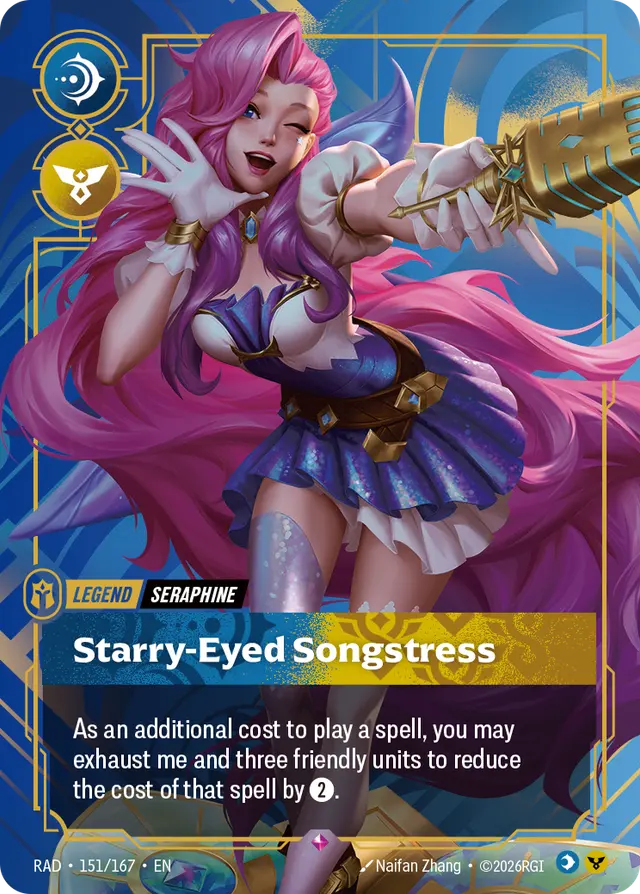 Starry-Eyed SongstressRAD-151/167
More ready-made decks are on the way. Legacy, the sixth set, with its release on 29 January 2027, brings Champion Decks for Tryndamere, Ashe, Lux and Garen. Proving Grounds, 2nd Edition, with its release on 19 February 2027, holds new decks for Heimerdinger, Karma, Vladimir and Illaoi. The article on which product to get first weighs these boxes against booster packs and the other products, and the article on which starter deck to pick names the Legends that are easiest to learn with.
How do you learn the rules of Riftbound?
The quickest way by far to learn Riftbound is to have a friend or someone you know who already plays teach you during a real first game, explaining each step as you go. A teacher at the table answers each question the moment it comes up. Without such a teacher, read the booklet in the box and then play. Every ready-made product comes with a rules booklet. The one in Proving Grounds explains the parts of a deck, the setup, the steps of a turn and combat in 24 small pages. Riot's quick start guide on playriftbound.com covers the same basics in a few minutes of reading. That guide dates from June 2025 and has each player bring one battlefield, while a deck for the full rules holds three.
The heart of the game is short. Runes pay for your cards, and you channel two of them at the start of each turn. Your units move to the battlefields in the middle of the table, and you score a point for taking a battlefield and another for each one you still hold at the start of your turn. The first player to reach 8 points wins.
The full Core Rules on Riot's Rules Hub were last updated on 9 October 2026 and run to 142 pages, so they are a reference to look things up in, not a place to start. One of their rules helps more than any other while you learn: when a card says something different from the rules, the card is right. The article on the quickest way to learn the rules names the six ideas a first game needs and the guides and videos that teach them.
How should you play your first game?
Your first game is best played at home or at a quiet table, as a one-on-one Duel with two ready-made decks. A Duel is the standard way to play: two players, two battlefields in play and 8 points to win. Proving Grounds can also be played by three or four players, but those modes change a few rules and are easier to pick up after some Duels. A few habits make the first games smoother.
- Play the first game with both hands face up and talk each turn through. Nobody needs to win it.
- Keep the booklet open at the steps of a turn, since the start of each turn has four steps in a fixed order.
- Say the score out loud every time someone scores, because the last point follows its own rule.
- Play a second game with the decks swapped, so each player sees how the other Legend works.
The article on what you need for a game lists everything that goes on the table, and the article on playing at home with a friend covers games away from a store.
Where can a beginner play Riftbound with other people?
A beginner can play at a local game store that runs Riftbound events. Stores host several kinds of events, and three of them suit new players well.
- Learn to Play events are made for people who have never played, and they are the next best thing to a friend who teaches you. The store teaches the game and lends you a deck, so you need no cards of your own. Some stores end the event with a few rounds against the other new players.
- Nexus Night is the weekly event of a store, on the day the store picks. The store also picks the format: Constructed with your own deck, Sealed with a deck built from packs opened at the table, or a format built on the Champion Decks. Players usually get a Nexus Night promo pack for taking part, for as long as the store's supply lasts.
- Pre-Rift events are held in the week before a set releases. Each player receives a kit with a small ready-made deck of 15 cards, five booster packs of the new set and a promo card, and builds a deck from it to play with. The Pre-Rift events of Radiance are set for 16 to 22 October 2026, the week before the release of Radiance on 23 October 2026. Every store has a limited number of kits, so it is best to ask for a seat early.
The event finder shows the events near you with their day, their format and the seats still free. The article on where to play with other people says more about each kind of event.
When should you build a deck of your own?
You are ready to build a deck of your own once your ready-made deck feels familiar, usually after a handful of games. Most players start by changing a ready-made deck rather than building one from nothing. They open booster packs or pick single cards, and swap a few cards at a time for ones that suit their Legend better. Single cards come from local game stores and from marketplaces such as Cardmarket in Europe, TCGplayer in the United States and CardTrader on both sides of the Atlantic.
A deck you build yourself follows a few rules. It has one Legend, a main deck of at least 40 cards with your chosen champion counted among them, a rune deck of exactly 12 runes and, for a Duel, three battlefields with different names. Every card has to fit the two domains of the Legend, and the main deck holds at most three copies of a card and at most three signature cards. The deck builder checks all of this while you build, and the decks page shows the decks of other players next to the ready-made decks sold in a box. The article on building your first deck takes you through it.
What comes after your first events?
After a few Nexus Nights, some players look for a more competitive event. Summoner Skirmish is the competitive store tournament of each set, played one on one in best of three matches. Riot has announced that the Skirmishes of the Radiance season, from 9 November 2026 to 17 January 2027, are the last, and that the Riftbound Challenge Series takes their place in 2027, next to a new monthly Nexus Cup in stores. Many players never enter a competitive event and stay with Nexus Night and games among friends. The article on the kinds of Riftbound tournament explains the steps above the store level.
Before you pick a product, the products guide shows every ready-made product and what is inside it, and the champions page shows who each champion is. A Champion Deck had a launch price of $19.99, and the Vi deck of Unleashed sells for $15.60 today. The article on how much it costs to start sets every starter box beside the entry fees of store events and the price of accessories.
Prices marked with a dot are live market prices.