What is in a Riftbound booster pack?
A Riftbound booster pack holds 14 cards from one set: seven Commons, three Uncommons, two cards of Rare or better, one foil card and one rune or token. A pack has a launch price of $4.99 and a display holds 24 of them.
- 5 min read
- Updated Oct 13, 2026
The booster pack is the basic product of Riftbound: the League of Legends trading card game. Every main set comes in booster packs, and every card of a set, from the Commons to the rarest showcase printings, can turn up in one. Knowing what a pack holds tells you what you can expect from it and what you should not count on.
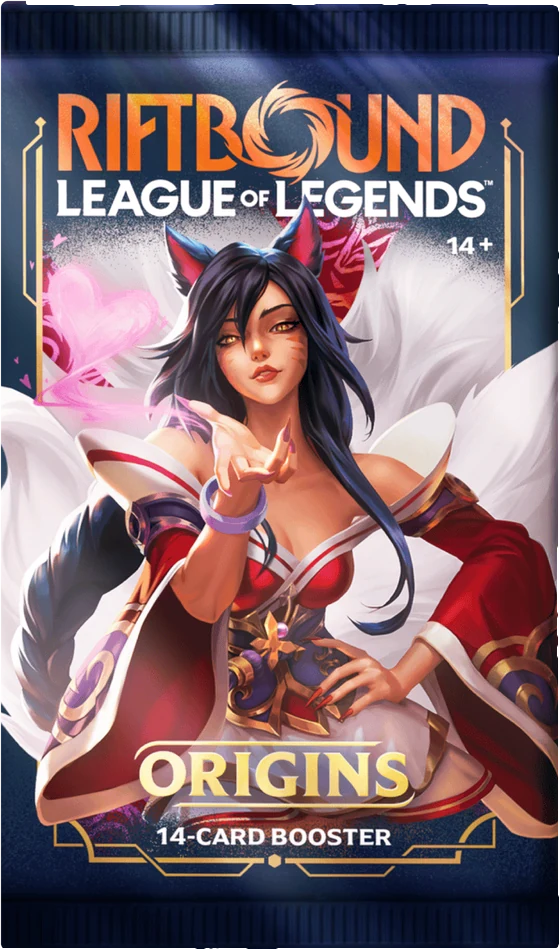
How many cards are in a Riftbound booster pack?
A Riftbound booster pack holds 14 cards from one set, plus an informational insert that does not count. The 14 cards always come in the same slots, so every pack of a set is built the same way, and only the rare slots, the foil slot and the last slot can surprise you.
| Slot | Cards |
|---|---|
| Commons | 7 |
| Uncommons | 3 |
| Rare, Epic or a showcase printing | 2 |
| Foil Common, Uncommon, Rare or Epic | 1 |
| Basic rune or token, now and then an alternate art rune | 1 |
Every Rare and Epic card in a booster pack is foil, so the two rare slots always hold shiny cards. The foil slot is where a Common or an Uncommon can come as a foil card, and in Origins the last slot now and then holds a foil rune too.
What can the rare slots hold?
Most of the time the two rare slots hold two Rares. About one pack in four has an Epic in place of one of them. Much less often a rare slot holds a showcase printing with the gold Showcase gem. Riot published these odds for Origins in its article on collectability and has not published new ones for later sets, apart from the Ultimate Rares. Riot gives every one of these pull rates as an average over the whole print run, so a single pack can hold more or fewer showcase printings than the odds suggest.
- An alternate art card turns up in about one pack in twelve, so a booster display of 24 packs holds about two.
- An overnumbered card turns up in about one pack in 72, which is about one in every three displays.
- In Origins about one overnumbered card in ten is signed by the artist.
- Unleashed and Radiance each have an Ultimate Rare, the rarest card of its set: fewer than one pack in 1,000 for Unleashed, and about one pack in 4,000 for Radiance, with its release on 23 October 2026.
The rarity guide shows each gem with example cards and the odds of every printing per set.
How is a Radiance booster pack different?
Radiance, the fifth set, with its release on 23 October 2026, keeps the 14 cards but splits the rare slots in two. One slot always holds a Rare or an Epic. The other is the only slot that can hold a showcase printing: it holds a Rare, an Epic, an alternate art card, a special printing, an overnumbered card or the Ultimate Rare. The last slot can hold a token, a rune or an alternate art rune. In its overviews of Unleashed and Vendetta, Riot lists both rare slots as able to hold a showcase printing, while its overview of Radiance allows it in one slot only.
What does a booster pack cost?
A single Riftbound booster pack has a launch price of $4.99, and a booster display of 24 packs has one of $119.99. Game stores and marketplaces set the prices they ask themselves, so a pack can sell for more than its launch price, as the first sets did when demand went far past what Riot had printed. Today the Origins booster pack sells for $12.70 and the Vendetta booster pack for $7.47. The products guide lists the booster pack and the display of every set with its launch price and its contents.
Is a booster pack a good way to start?
A booster pack is fun to open, but it is not a deck. Fourteen random cards from one set rarely fit together, and the rune or token in the last slot does not make a rune deck. A new player gets more out of a ready-made deck first, and which product to get first depends on who you play with: Proving Grounds suits two or more people who learn together, and a Champion Deck suits one player who wants to play at a store. Boosters come after that, to add cards to a deck that already works.
A player who needs particular cards for a deck gets there sooner with single cards, which come from local game stores and from online marketplaces: Cardmarket in Europe, TCGplayer in the United States and CardTrader on both sides of the Atlantic.
If you want to see what a pack of each set can hold without opening a real one, you can rip a pack on this site. The pack opener opens a pack of any set at Riot's published rates for the rare slots and shows what each card sells for.
Will booster packs change?
Yes, from the sixth set. In its announcement of 3 August 2026, Riot said that from Legacy, with its release on 29 January 2027, a booster pack holds six Commons instead of seven. The freed slot holds a Legend or a battlefield, about half the time each. Riot says the showcase printings of Legends and battlefields stay in the slots of the overnumbered cards.
Prices marked with a dot are live market prices.