Can you play Riftbound at home with a friend?
Yes. Riftbound is played face to face with physical cards, so two friends need only a complete deck each and a table. A Showdown box or Proving Grounds gives both players a deck at once, and a game at home follows the same Core Rules as a game in a store, without a judge.
- 6 min read
- Updated Oct 13, 2026
Riftbound: the League of Legends trading card game is played with physical cards across a table, so a living room works as well as a game store. The Core Rules start from the idea that every player brings their own cards, and nothing in them asks for a store, a judge or an app. Two friends with a complete deck each can play a full game at home, by the same rules as anywhere else.
What do you need for a game at home?
Each player needs a complete deck. For a one-on-one Duel, that is a Legend, a main deck of at least 40 cards with the chosen champion among them, a rune deck of 12 runes and three battlefields with different names, of which one is picked at random before the game. A Showdown deck or a Champion Deck holds all of these out of the box.
Everything else a game needs can come from the house. The Core Rules let anything stand in for a token, so a coin or a spare card does the job when a card creates one. Damage on a unit can be marked with coins, dice or other markers, or simply remembered, and XP can be kept with counters, dice or anything else that shows the number clearly. A die or a sheet of paper keeps the score. A playmat helps keep your decks, your base and your trash in their zones, but a bare table works too.
Which products give two friends a deck each?
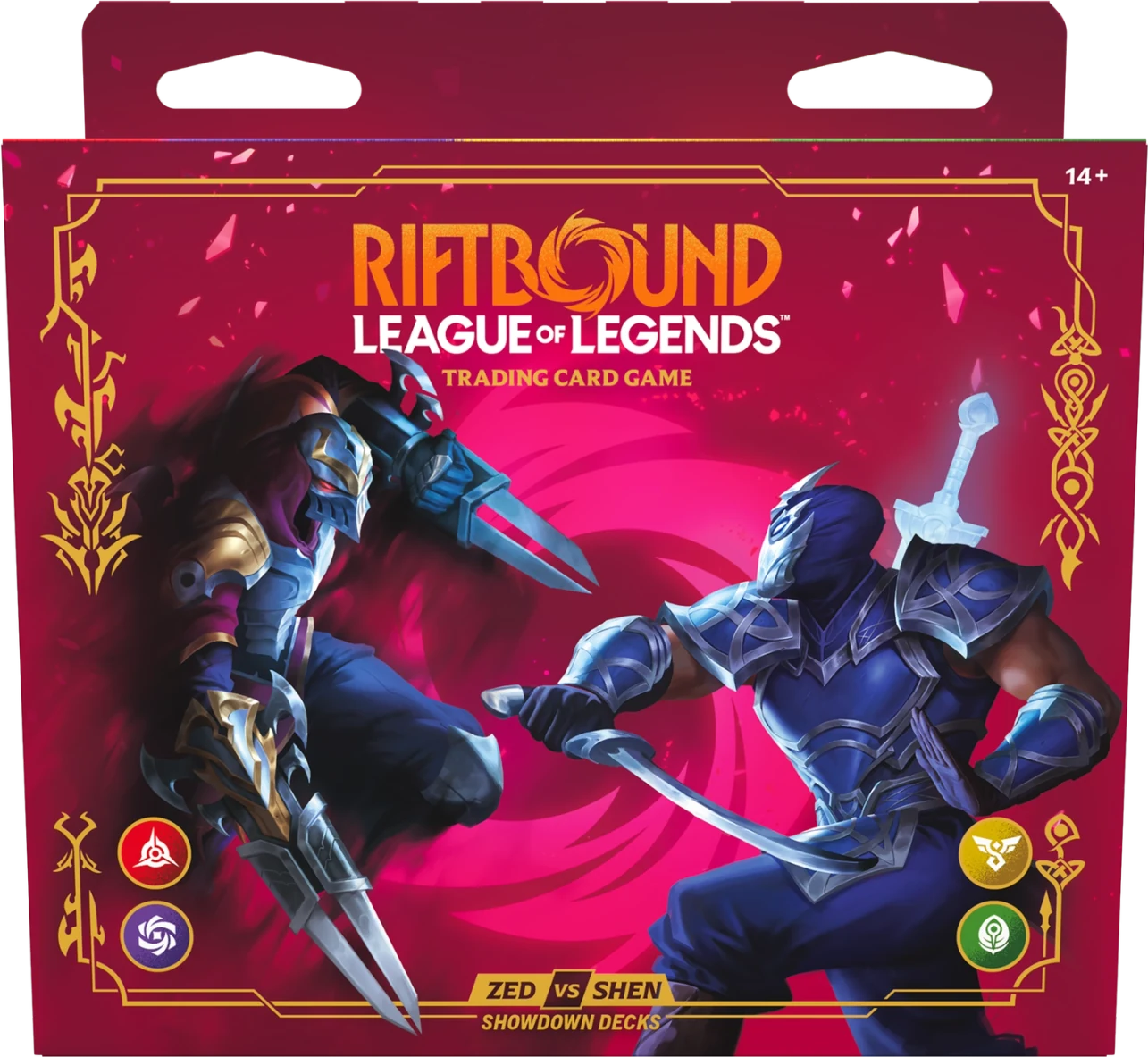
A Showdown box is made for exactly this. It holds two complete decks of 56 cards made to face each other, two booster packs, and a paper playmat and a deck box for each player, and its launch price is $34.99. The Vendetta box puts Zed against Shen, and the Radiance box puts Seraphine against Evelynn, with its release on 23 October 2026.
Two other choices for two players work as well. Proving Grounds, the starter box, holds four ready-made decks for Annie, Garen, Lux and Master Yi, so two players can each pick one and still have two left to try. Each Proving Grounds deck brings one battlefield, which is how the booklet in the box sets up a game. Two Champion Decks let each player choose their own champion, at a launch price of $19.99 each.
Do the official rules apply at home?
Yes. The Core Rules are the rules of the game wherever it is played. The Tournament Rules, with their judges, decklists and penalties, are written for organized events. At a kitchen table, the two players settle any question between themselves.
Two habits make that easy. When a card and the rules say different things, the card wins: that is the Golden Rule, the very first rule of the Core Rules. When neither player is sure of an answer, the full Core Rules are on Riot's Rules Hub.
The quickest way by far to learn Riftbound is to have a friend or someone you know who already plays teach you during a real first game, explaining each step as the game goes. A game at home suits this well, because the teacher can stop at any moment to explain a card or a rule. While they learn, friends can also agree on looser habits, such as playing with open hands or taking back a move.
Friends can also choose how long to play. A Duel is a single game to 8 points. A Match is the best of three games: each player chooses one of their three battlefields for each game instead of drawing one at random, and a battlefield used in a game that someone won cannot be chosen again.
Can three or four people play at home?
Yes. The Core Rules have three game modes for more than two players, and all of them work at a home table.
- Skirmish is a free-for-all for three players, with three battlefields in play and 8 points to win.
- War is a free-for-all for four players. It also has three battlefields in play, because the player who goes first does not put one in.
- Magma Chamber is a game for two teams of two. Each team shares one score and plays to 11 points.
In all three modes, the player who goes first skips their first draw, and the player who goes last channels an extra rune on their first turn. Proving Grounds holds four decks, so one box is enough for a game of War or Magma Chamber. The four Proving Grounds decks are led by the Legends Dark Child for Annie, Wuju Bladesman for Master Yi, Lady of Luminosity for Lux and Might of Demacia for Garen.
 Dark Child, StarterOGS-017/024
 Wuju Bladesman, StarterOGS-019/024
 Lady of Luminosity, StarterOGS-021/024
 Might of Demacia, StarterOGS-023/024
Can you play with booster packs instead of ready-made decks?
Yes, but it is not the usual way to play Riftbound. The usual game is played with a deck put together before the game, such as a ready-made deck, and the Tournament Rules call that format Constructed. Sealed, in which each player builds a deck from booster packs opened at the table, is one of the formats stores run at some of their events.
A beginner should start with a ready-made deck rather than Sealed. A ready-made deck is built by Riot to play well from the first game, while a Sealed deck has to be built from a pile of random cards, which is much easier once you know the game. Once both players know the rules, Sealed works just as well at home. Each player opens six booster packs and builds a deck from what they find, and the Tournament Rules loosen the deck rules for it.
- The main deck needs at least 25 cards, and it may hold more than three copies of a card if the packs gave them.
- The deck may use any three domains, or one domain next to the two domains of its Legend.
- The rune deck of 12 runes has to match those domains, but its basic runes may come from anywhere, such as a ready-made deck you already own.
- A player who is short of battlefields may use blank ones without text, and at casual events anything the players agree on can stand in for them.
A booster display holds 24 packs, which is six packs each for four players, or a Sealed game for two with half a display left over. Draft, the other format played from packs, is made for groups of about eight players, so it suits a games night better than two friends.
How do you keep games at home interesting?
Swap decks after a game or two, so each player learns how the other Legend wins. Once the ready-made decks feel familiar, improve them: open the booster packs that come with a Showdown box or a Champion Deck, or swap in single cards that suit the Legend better. Single cards come from local game stores and from marketplaces such as Cardmarket in Europe, TCGplayer in the United States and CardTrader on both sides of the Atlantic. The deck builder checks a deck against the rules while you build it, and the decks page shows the decks other players share and the ready-made decks sold in a box.
When you want new opponents, a local game store is the easiest place to play with other people. Many stores that sell Riftbound run a weekly Nexus Night, and the event finder shows the events near you. A friend who lives too far away for a shared table can still play Riftbound online over a video call, with each player's own cards on their own table and a camera pointed at it.