Which Riftbound product should you get first?
For most new players the best first Riftbound product is a ready-made deck. Proving Grounds suits two to four people who learn together, a Showdown Decks box suits two, and a Champion Deck suits one player who wants to play at a store. Booster packs, a display or a Vault make more sense after the first deck.
- 8 min read
- Updated Oct 13, 2026
Riftbound: the League of Legends trading card game comes in many kinds of boxes, and on a store shelf a booster display, a Vault and a Champion Deck can look much alike. Only some of them can be played the day they are opened. For a first product, the question that matters most is not which box holds the best cards but who you will play with, and where.
Why is a ready-made deck the best first product?
A ready-made deck is the best first product because it is the only kind of box you can play with straight away. A deck needs one Legend, a Main Deck of at least 40 cards, a Rune Deck of 12 runes and its battlefields, and every card has to fit the two domains of the Legend. A ready-made deck holds all of that, built around one champion, with a booklet that explains the rules. A booster pack holds 14 random cards from one set, and just one slot in it holds a rune or a token, so a few packs rarely add up to a deck.
Riot gives the same advice. Its deckbuilding primer of July 2025 suggests starting with a deck Riot built, such as a Champion Deck, and changing it card by card as you learn how it plays. Three kinds of product hold ready-made decks: the Champion Deck, the Showdown Decks box and the Proving Grounds starter box. The table sets them beside the products that hold only booster packs, with the launch price of each.
| Product | Ready-made decks | Booster packs | Launch price |
|---|---|---|---|
| Champion Deck | 1 | 1 | $19.99 |
| Showdown Decks | 2 | 2 | $34.99 |
| Proving Grounds, first printing | 4 | 0 | $29.99 |
| Proving Grounds, reprint of 2026 | 4 | 0 | $39.99 |
| Vault | 0 | 6 | $34.99 |
| Booster display | 0 | 24 | $119.99 |
Which product suits two or more people who learn together?
Two to four people who have never played do best with Proving Grounds, the starter box. It holds four decks built around Annie, Garen, Lux and Master Yi, made to be even against each other, along with four acrylic champion figures to keep score with and a How to Play booklet that teaches the game in the order a first game needs it. Of the four decks, the Garen deck is the simplest to start with: its Legend, Might of Demacia, draws two cards when you conquer a battlefield with four or more of your units there. Today the box sells for $53.13.
Two people who want decks by the full rules do better with a Showdown box. It holds two complete decks of 56 cards made to play against each other, each with the three battlefields a Duel asks for, along with two booster packs, two paper playmats and two deck boxes. UVS Games, which manufactures Riftbound, pitches the Showdown Decks at players who want two decks ready to go out of the box or want to play with a friend right away. The Vendetta box sets Zed against Shen, and Shen is the simpler side: his Legend, Eye of Twilight, gives a friendly unit Tank for the turn. The Vendetta box sells for $15.14 today. The Radiance box, with its release on 23 October 2026, sets Seraphine against Evelynn.
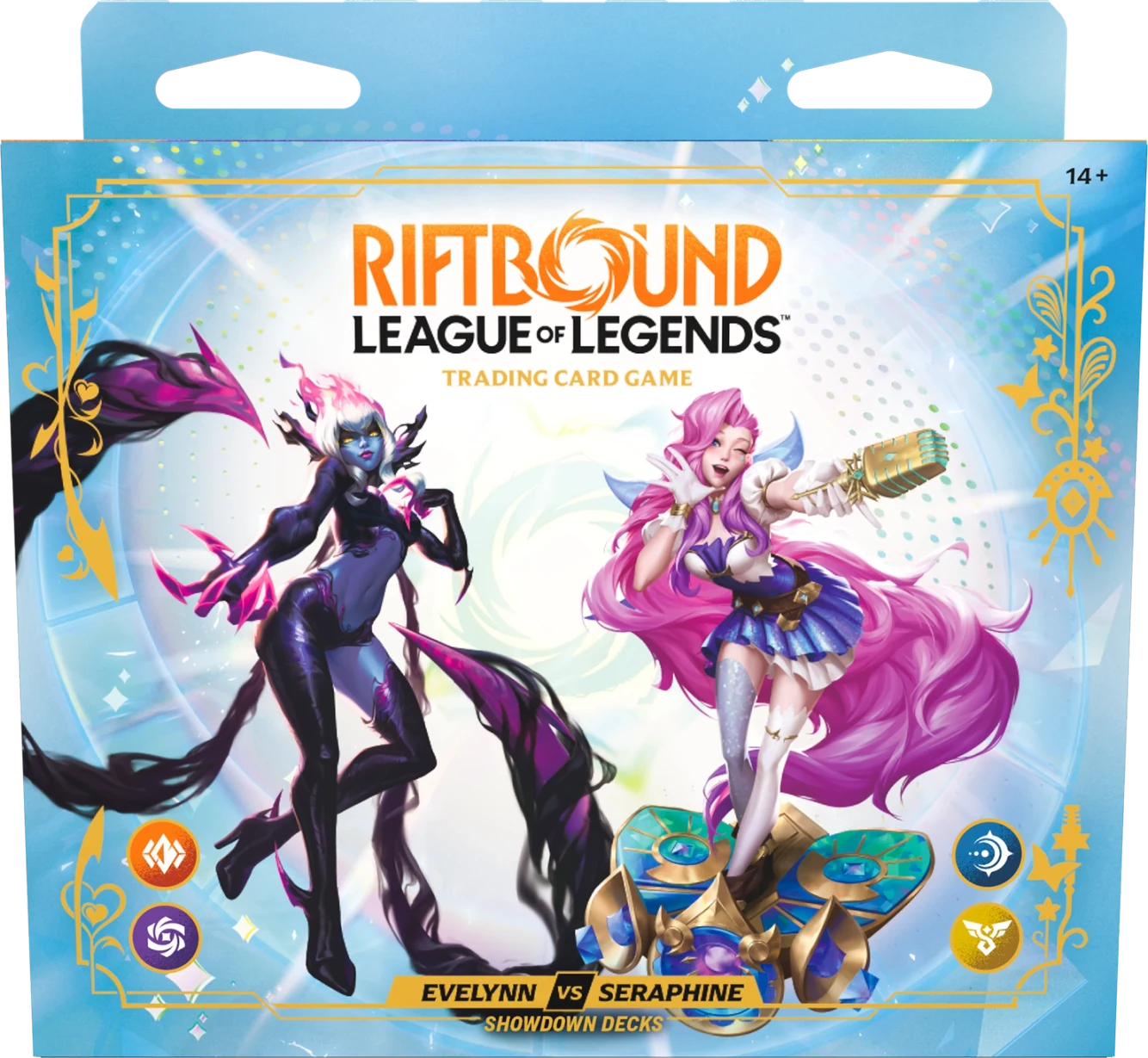
The difference between the two boxes shows once you go to a store. Each Proving Grounds deck brings one battlefield, so it needs two more before it can go to a store event. A Showdown deck can go the day it is opened. Of the products made for two players, Proving Grounds is the gentler start, and a Showdown box is the better one for two players who expect to play at a store soon.
Which product suits one player who wants to play at a store?
One player who wants to join the games at a local store does best with a Champion Deck. It is one complete deck of 56 cards with a booster pack, a paper playmat and a rules booklet, at a launch price of $19.99. Today the Jinx deck sells for $33.02. Seven Champion Decks came out with the first three sets: Jinx, Viktor and Lee Sin with Origins, Fiora and Rumble with Spiritforged, and Vi and Vex with Unleashed. Every set so far is legal in Standard, so an Origins deck is as welcome at a store as a newer one.
Pick the champion you like most, because you will see its Legend in every game. If you have no favorite, a Legend that works without a decision every turn is easier to learn with, and three of the seven Champion Decks have one. Mechanized Menace, the Legend of the Rumble deck, gives your Mechs Shield at all times. Gloomist, the Legend of the Vex deck, lets you draw a card when you hold a battlefield, for nothing more than exhausting the Legend. Loose Cannon, the Legend of the Jinx deck, draws you a card at the start of your Beginning Phase when you have one card or none in hand.


The Jinx deck holds seven copies of three cards that are now banned in Constructed: three Fight or Flight, three Scrapheap and the battlefield Reaver's Row. The Tournament Rules let you play the deck unchanged at casual events such as Nexus Night (rule 601.2.d.2), but once you change a card, all seven have to go.
You do not have to get anything to try the game first. Most Learn to Play events are free, and the store lends you a deck. A new player who already knows the basic rules can also start at a Pre-Rift event in the week before a set releases. Its entry fee, most often 30 to 40 dollars or euros, covers five booster packs of the new set and a 15-card deck with a Legend and a champion unit, and every player builds a deck from them at the table. The Pre-Rift events of Radiance are set for 16 to 22 October 2026, and the event finder shows the events near you.
When are booster packs or a display the right first product?
Booster packs are the right first product for a collector, or for a player who already has a deck to add to. A pack has a launch price of $4.99. A booster display of 24 packs has a launch price of $119.99, which is no discount on 24 packs bought one at a time ($119.76). Whether a display is worth it therefore depends on what you want from it: a whole set at once, or a Sealed evening at home, where each player opens six packs and one display serves four players.
Collector sets are no way into the game at all: the Arcane Box Set, for example, holds six foil cards with art from the Arcane series, one each for Jinx, Vi, Heimerdinger, Caitlyn, Viktor and Warwick, and no deck.
What should you get after your first deck?
After the first deck, get what the deck is missing rather than more random cards. Three things help most.
- Single cards. A ready-made deck improves fastest with a few chosen cards, and upgrading a Champion Deck starts with more copies of its champion and its signature card. A deck needs particular cards in particular numbers, so single cards are usually quicker than packs for that. Single cards come from local game stores and from online marketplaces: Cardmarket in Europe, TCGplayer in the United States and CardTrader on both sides of the Atlantic. Today a single Jinx, Demolitionist, the champion unit of the Jinx deck, sells for $0.28.
- A Vault. A Vault holds six booster packs, a full set of 36 basic runes with six of each domain and a storage box, at a launch price of $34.99. Six runes of each domain make the usual Rune Deck of six and six for any Legend, which packs alone rarely give you. Unleashed and Vendetta each have a Vault, and Radiance gets one with its release on 23 October 2026.
- A second deck. A second ready-made deck gives a friend something to play against.
Is it worth waiting for the starter products of 2027?
No, waiting gains a new player nothing. Legacy, the sixth set, with its release on 29 January 2027, brings Champion Decks for Tryndamere, Ashe, Lux and Garen. Proving Grounds, 2nd Edition, with its release on 19 February 2027, holds new decks for Heimerdinger, Karma, Vladimir and Illaoi, and Riot's announcement of 3 August 2026 gives it a launch price of $40. Both teach the same rules as the boxes in stores today. Riot plans to start rotation, when the oldest sets leave Standard, only in 2028, as its Rules Hub says, so a deck from the sets out now stays legal in Standard until then, unless a card in it is banned.
The products guide shows every product with its launch price and the cards inside it, and the decks page lists every deck sold in a box card for card. A first deck is only the start of what playing costs, which depends on whether you play at home, at a store event or at tournaments, and how much it costs to start playing Riftbound adds up a typical start.
Prices marked with a dot are live market prices.