What is a Riftbound booster display (booster box)?
A booster display is the sealed box of 24 booster packs from one Riftbound set, 336 cards in all, which game stores also sell single packs from. Players often call it a booster box. Every display from Origins to Radiance has a launch price of $119.99.
- 6 min read
- Updated Oct 13, 2026
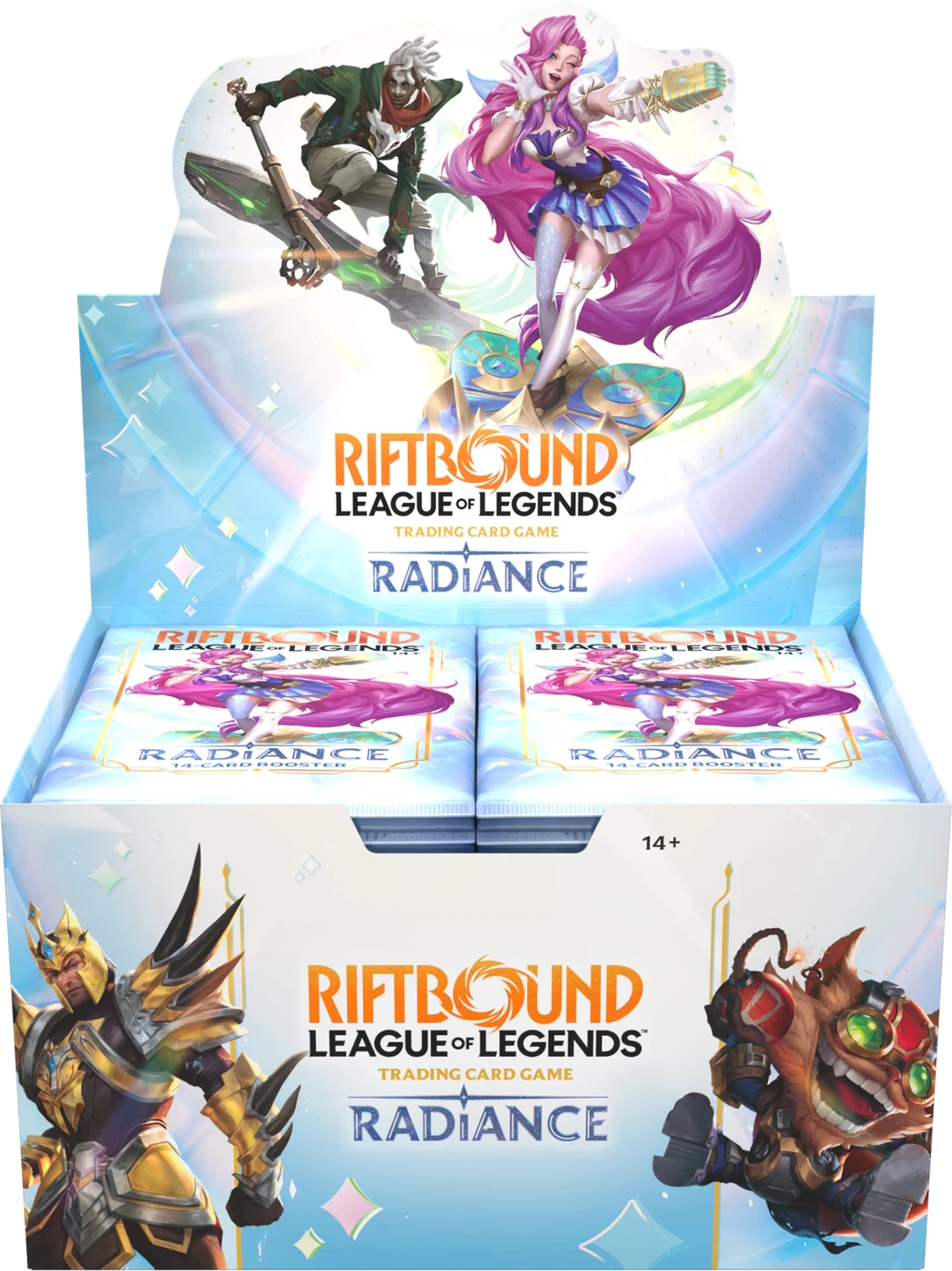
A booster display is the sealed box of booster packs of Riftbound: the League of Legends trading card game. Every main set comes in one, and each display holds 24 packs of that set. The box is made to stand open with the packs on show, so a game store can sell the packs one at a time straight from it. Players who get the whole box often call it a booster box, and Riot's own article on collectability counts cards per box as well.
What is inside a Riftbound booster display?
A booster display holds 24 sealed booster packs from one set, and Riot lists nothing else in the box. Riot's store pages for the English displays of all five main sets give the same count, for example the page of the Radiance display. Every pack holds 14 cards in fixed slots, sorted by rarity, plus an informational insert, so one display holds 336 cards in the numbers below.
| Slot | Per pack | Per display |
|---|---|---|
| Commons | 7 | 168 |
| Uncommons | 3 | 72 |
| Rare or better, always foil | 2 | 48 |
| Foil card of any rarity | 1 | 24 |
| Rune or token | 1 | 24 |
| All cards | 14 | 336 |
The slots are the same in every pack, so these totals hold for every display of a set. Every card of Rare or better is foil, and the last slot holds a rune or a token. Radiance changes the two rare slots a little, as the article on what is in a booster pack explains.
Which rare cards can you expect from one display?
Every display holds at least 48 cards of Rare or better, two from every pack. Which of them are Epics or showcase printings is a matter of averages. Riot's store page for the Origins display and its page for the Spiritforged display say a box holds more than six Epics and more than two alternate art cards on average. For Origins, Riot's article on collectability also puts overnumbered cards at about one per three boxes, with the artist's signature on about one overnumbered card in ten.
The four Spiritforged cards below show what a display brings beyond its Rares: two Epics, Ezreal, Prodigy and Fiora, Worthy, and the alternate art printings of the same two cards, Ezreal, Prodigy and Fiora, Worthy.
 Ezreal, ProdigySFD-149/221
 Fiora, WorthySFD-180/221
 Ezreal, ProdigySFD-149a/221
 Fiora, WorthySFD-180a/221
The Ultimate Rares are far rarer than one per display. Riot puts the Ultimate Rare of Unleashed in fewer than 0.1 percent of packs, which is fewer than one in 40 displays, and the one of Radiance in about 0.025 percent of packs, which is about one in 167 displays. Riot says every rate is an average over the whole print run and not a guarantee for a pack or a display, and that no pack, box or case is sure to hold an Ultimate Rare. Pull rates are averages in this way for every printing: one display can hold several alternate art cards while the next holds none.
How many players can one display serve in Sealed or Draft?
One display is enough for a Sealed event of four players or a Draft table of eight. In Sealed, the Tournament Rules give each player six unopened packs to build a deck from (rule 602.4.a.1), so 24 packs make four card pools. In Draft, each player gets three packs and a table seats as close to eight players as possible (rules 602.4.b.1 and 602.4.b.2), so one display fills one table exactly. In two-versus-two Sealed, each team shares a pool of eight packs (rule 603.6), so a display covers three teams.
Stores use displays too. The event kit that a store gets for the Pre-Rift events of Radiance holds 16 player kits, each with a small ready-made deck, five Radiance booster packs and a promo card, and one Radiance booster display for prizes, according to UVS Games' Radiance dates and details. A display also makes a games night for four friends at home, since 24 packs give each of them six packs for Sealed, as the article on playing at home describes.
What does a booster display cost?
Every booster display from Origins to Radiance has a launch price of $119.99 in Riot's own store. A single booster pack has a launch price of $4.99, so 24 packs bought one by one come to $119.76. At launch prices, a display therefore costs the same as its packs, give or take a few cents, and is not a discount. What a display gives you is the whole box of one set at once.
Riot's store sells displays but not single packs, and it allows one display of a set per Riot ID in each print run. Displays are also sold in local game stores and by other retailers that carry Riftbound, and sealed displays are listed on the marketplaces Cardmarket in Europe, TCGplayer in the United States and CardTrader on both sides of the Atlantic. Those sellers set their own prices, and a display that is hard to find can sell above its launch price, as why products sell above their launch price explains. Today the Origins display sells for $221.90 and the Unleashed display for $175.95.
Which booster displays are there?
There is one booster display for each main set: Origins, Spiritforged, Unleashed, Vendetta and Radiance, the last with its release on 23 October 2026. A display comes out on the same day as the booster packs of its set. Proving Grounds, the starter box, has no display, because it holds ready-made decks and no booster packs.
A few products for players hold some booster packs as well: the Radiance Showdown Decks come with two Radiance booster packs, and a Radiance Pre-Rift player kit holds five. Riot has announced booster packs and displays for the next two sets as well: Legacy, with its release on 29 January 2027, and The Reckoning, with its release on 30 April 2027. In its announcement of the products of 2027, Riot says that from Legacy on, each pack holds six Commons instead of seven, and a slot dedicated to either a Legend or a battlefield takes the place of the seventh Common, at roughly even odds.
Who should get a booster display?
A display suits a player who wants to collect a set, wants many cards of one set at once or plans a Sealed or Draft evening with friends. It is not the best first product for a new player, because 24 packs of random cards do not make a deck on their own and a ready-made deck plays at once. Whether a display is worth it depends on what you want from the 24 packs: the opening itself, a set to collect and a Sealed or Draft evening are what a display is good for, while the particular cards of a deck come sooner as single cards. Single cards come from local game stores and from online marketplaces: Cardmarket in Europe, TCGplayer in the United States and CardTrader on both sides of the Atlantic.
The products guide lists the booster display of every set with its launch price and release date. To see what the packs of a set can hold before you get a whole box, you can rip a pack on this site and compare the cards with the odds in the rarity guide.
Prices marked with a dot are live market prices.