Do older sets stay legal in Riftbound?
Yes, for now. Every Riftbound set released so far is legal in Standard, Radiance joins on 23 October 2026, and a new set only adds to it. Riot plans the first rotation for the start of 2028, when Origins and the four sets of 2026 are to leave Standard for other formats.
- 7 min read
- Updated Oct 13, 2026
Riftbound: the League of Legends trading card game gets a new set about every three months, and so far no new set has pushed an older one out. A deck of Origins cards from October 2025 is as legal at a tournament as a deck of the newest cards. Riot plans to change that from 2028 with rotation: once a year, the oldest sets will leave Standard for other formats.
Which sets are legal in Riftbound right now?
Every set Riot has released is legal in Standard, the main Constructed format of Riftbound, where each player brings a deck built ahead of time. The Tournament Rules of 9 October 2026 list the sets of Standard in rule 601.3.c: Origins, the Origins supplemental set of 24 cards from the Proving Grounds starter box, Spiritforged, Unleashed, Vendetta and Radiance, which joins on its release date of 23 October 2026. Riot's Rules Hub adds that every set made so far is legal at sanctioned events, from the local store to the largest tournaments, and in 2v2 Constructed as well.
The six Legends below come from those six sets, one from each: Dark Child of Annie from the Origins supplemental set, Loose Cannon of Jinx from Origins, Prodigal Explorer of Ezreal from Spiritforged, Wuju Master of Master Yi from Unleashed, Eye of Twilight of Shen from Vendetta and Starry-Eyed Songstress of Seraphine from Radiance. Every one of them can lead a Standard deck, the Radiance Legend from the release date of its set.
 Dark Child, StarterOGS-017/024
 Loose CannonOGN-251/298
 Prodigal ExplorerSFD-199/221
 Wuju MasterUNL-191/219
 Eye of TwilightVEN-147/166
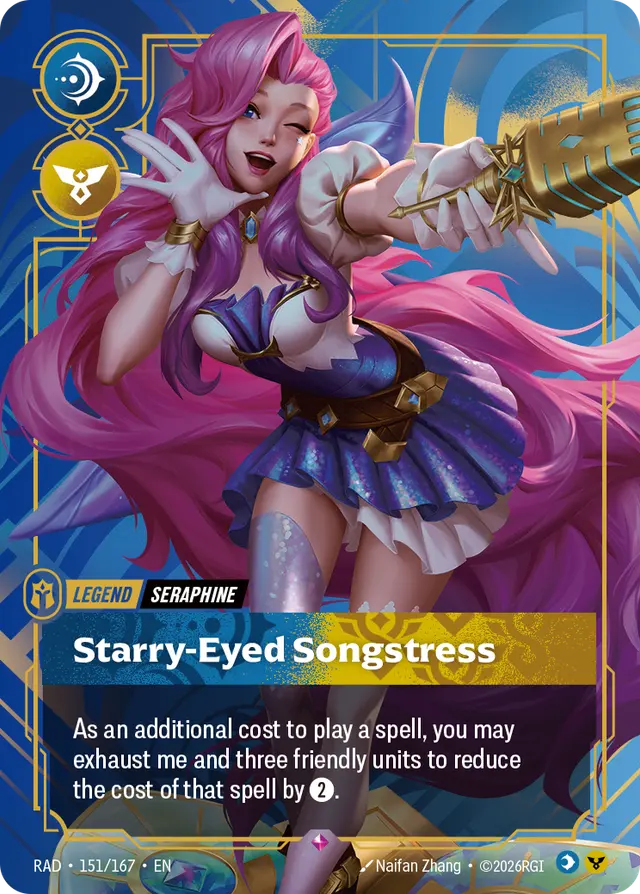 Starry-Eyed SongstressRAD-151/167
A banned card is a different matter: it may not be in a deck of a format where it is banned, whatever its set (rule 601.2.d), and Riot updates its list from time to time, as the article on how Riftbound cards are banned or changed explains.
When does rotation start?
Riot plans to start rotation in 2028. The format legality on the Rules Hub, last updated on 18 September 2026, says that Riot intends to introduce rotation of legal sets in Standard starting in 2028, and Riot's State of the Game of 3 August 2026 named the same year. Riot gave its reason in its overview of organized play of 28 July 2025: rotation keeps the format fresh, healthy and accessible to newer players.
Until then, every new set adds to Standard and none leaves it. In its plan of products and sets into 2027, Riot has dated Legacy, the sixth set, for 29 January 2027 and The Reckoning, the seventh, for 30 April 2027, and it plans two more sets for the third and fourth quarters of 2027. Under the plan, all four of them join a Standard that still holds Origins and every set after it.
Which sets will leave Standard first?
Origins and the four sets of 2026 are planned to leave together. The overview of 28 July 2025 walks through the first two rotations, and the Tournament Rules of 9 October 2026 describe the same cycle: Standard is the most recent five to eight sets, made up of the current year's sets and the previous year's (rules 601.3.a and 601.3.b).
- Through 2027. The sixth to the ninth sets come out, and no set leaves Standard.
- At the start of 2028. The tenth set comes out, and the first five sets leave Standard: Origins, Spiritforged, Unleashed, Vendetta and Radiance. Standard then holds the four sets of 2027 and the tenth set.
- At the start of 2029. The fourteenth set comes out, and the four sets of 2027 leave, from Legacy to the ninth set.
After that, the same thing happens at the start of every year: the first new set of the year comes out and the four oldest sets leave, so Standard drops to five sets and grows back to eight by the end of the year. Riot has not given a name or a date for the tenth set yet. The plan also does not mention the 24 Proving Grounds cards on their own, which the Tournament Rules count as a supplemental set of Origins.
What happens to your cards after their set rotates?
They leave Standard, but Riot does not mean for them to leave the game. In the overview of 28 July 2025, Riot said it plans to create and support other formats for sets that have rotated out, so that players can keep playing their favorite champions and styles. In the State of the Game of 3 August 2026, Riot called this a future non-rotating format, still without a name, and said it hopes that format will be fun, fair and balanced, come 2028.
Two kinds of play are not touched by rotation at all. Sealed and Draft decks are built from the cards handed out at the event (rule 602.1.a.1), so the store decides which set is played when it chooses the packs. And at home, rotation matters only if you want it to: two friends can agree to play with any cards they own.
Does a reprint keep an older card in Standard?
A reprint in the normal numbering of a newer set does. The Tournament Rules allow a card in a deck when it comes from a set that is legal in the format, or when it has the same name as a card from such a set (rule 601.2.a). If a later set prints a card again inside its normal numbering, every copy of that card stays legal for as long as the later set does, the older printings included.
A showcase reprint does not count. A card printed again with a collector number outside the normal numbering of a set keeps the legality it already had (rule 601.2.c). Unleashed reprinted Poros from earlier sets this way: the overnumbered Daring Poro at 225/219 still counts as the Origins card Daring Poro, and the overnumbered Lonely Poro at 221/219 counts as the Spiritforged card Lonely Poro. A promo printing follows the card it reprints in the same way, since legality goes by the name of the card.


Will the booster packs of older sets still be sold?
In its State of the Game of 3 August 2026, Riot said it will keep the booster packs of a set available for at least as long as the set is legal in Standard, and reprint them to meet demand. Origins shows what this looks like: when demand outran the first print runs, Riot sent new waves of Origins boosters and a reprint of Proving Grounds to stores through the spring of 2026, as its update of 31 March 2026 describes.
That promise covers booster packs only. Riot sorts its other products into two groups. Ancillary products, made for a smaller part of the community, such as the Proving Grounds starter box, are kept in stores and can be reprinted when Riot sees the need. Collector's products are limited editions that Riot has said it will not reprint. So whether a sold-out product comes back and how long a product stays on sale both depend on which group it belongs to.
Should rotation change what you get or build now?
Not much. Under Riot's plan, every set from Origins to Radiance leaves Standard at the same time, at the start of 2028, so an Origins card and a Radiance card have the same time left in Standard, and a deck built from these sets stays legal until then, unless a card in it is banned. Legacy, with its release date of 29 January 2027, is the first set planned to stay in Standard until the start of 2029, so a player who plans for Standard beyond 2027 gets the most out of the sets of 2027.
A Standard deck that needs a few cards of an older set does not need that set's boosters. Single cards come from local game stores, from Cardmarket in Europe, from TCGplayer in the United States and from CardTrader on both sides.
Every card of every set is in the card list, with a page for each set from Origins to Radiance.
Riot plans rotation for Standard, so it helps to know which format an event uses, and the article on which formats are played at Riftbound events sets Standard, 2v2, Sealed and Draft side by side. With four sets a year and up to eight in Standard, the rotations of 2028 and 2029 take out five sets and then four, and the article on how often a new Riftbound set comes out lists the dates that set the pace.