What is a Riftbound Vault?
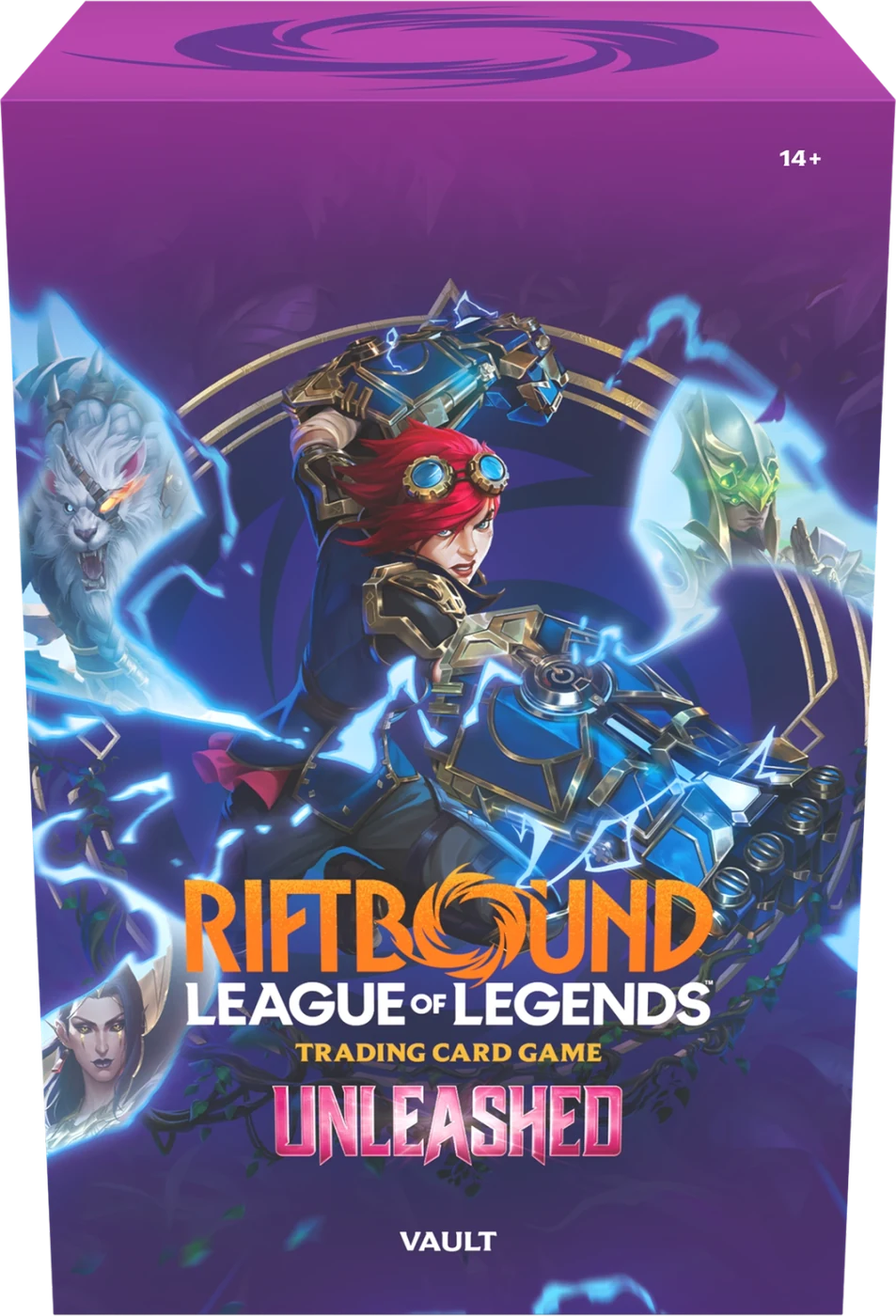
A Vault is a Riftbound product that comes with each main set from Unleashed on: a card storage box with six booster packs of its set, 36 basic runes with six of each domain and three full art tokens. Every Vault announced so far has a launch price of $34.99.
- 6 min read
- Updated Oct 13, 2026
A Vault is a boxed product of Riftbound: the League of Legends trading card game. It holds six booster packs of its set, a full set of basic runes and three full art tokens, packed in a card storage box that stays useful once the packs are open. Every main set from Unleashed, the third set, to Radiance, the fifth set, with its release on 23 October 2026, has a Vault. When Riot introduced the Vault with Unleashed in its overview of the set, it called it a new product and said that future sets would get a Vault of their own.
What is inside a Vault?
Every Vault announced so far holds six booster packs, 36 basic runes and three full art tokens in a storage box. The Unleashed Vault, the first of them, lists these contents:
- Six booster packs of Unleashed.
- 36 basic runes, six of each of the six runes.
- Three copies of one double-sided full art token card.
- Two punch-out art dividers to keep the cards in the box in order.
- A card storage box made for the Vault.
UVS Games, which makes Riftbound under license from Riot, lists the Unleashed Vault at 6.5 by 4.57 by 3.7 inches (16.5 by 11.6 by 9.4 centimeters) in its sell sheet for Unleashed.
The two Vaults after it keep the packs, the runes and the box and change the extras. The contents list of the Vendetta Vault names three double-sided full art tokens, as in Unleashed, but no dividers. The contents list of the Radiance Vault has two dividers again, and its three full art tokens are foil, as Riot's overview of Radiance says.
The six packs are booster packs of the set, like the packs in a booster display. A booster pack holds 14 cards in the same slots every time, so the packs of a Vault hold 84 cards between them. Every pack has two cards of Rare or better, which makes at least 12 in a Vault.
Why does a Vault hold 36 runes?
The runes are what set a Vault apart from six loose booster packs. Every deck needs a Rune Deck of exactly 12 runes, and each rune in it must match one of the two domains of the deck's Legend. A booster pack holds at most one rune, in the last slot that it shares with tokens, so collecting runes from packs is slow. There are six basic runes, one for each of the six domains: the Fury Rune, the Calm Rune, the Mind Rune, the Body Rune, the Chaos Rune and the Order Rune.
 Fury RuneOGN-007/298
 Calm RuneOGN-042/298
 Mind RuneOGN-089/298
 Body RuneOGN-126/298
 Chaos RuneOGN-166/298
 Order RuneOGN-214/298
With six of each basic rune, one Vault fills the Rune Deck of any Legend with six runes of each of its two domains. Its 36 runes even cover three such decks at once when no two of the decks share a domain. Bloodharbor Ripper, the Legend of Pyke, is Fury and Chaos. Curator of the Sands, the Legend of Nasus, is Calm and Mind. Exemplar of Demacia, the Legend of Jarvan IV, is Body and Order. One Vault holds the runes for all three of those decks.


A deck that wants more runes of one domain than of the other, such as eight and four, needs more than six of one rune. That takes a second Vault, the runes of a ready-made deck, runes from packs or single runes, which come from local game stores and from online marketplaces: Cardmarket in Europe, TCGplayer in the United States and CardTrader on both sides of the Atlantic. Today the Origins Fury Rune sells for $0.10 as a single card.
The runes are just as useful at Sealed and Draft events. The Tournament Rules let every player in those formats use any number of the six basic runes from any source, as long as they match the domains of the deck (rule 602.1.a.2). A player who brings the runes of a Vault therefore never depends on the runes in the packs they open.
What are the tokens and dividers for?
Tokens are game objects that spells and abilities create during play, such as a Gold gear or a Sprite unit. The Core Rules let anything stand in for a token (rule 181), but a printed token card shows the token's Might and text. At events, the Tournament Rules ask for a token to be shown by a card object that can show whether the token is ready or exhausted (rule 508.8), and a printed token card can be turned sideways for that.
The dividers carry art and split the cards in the storage box into groups. Riot describes them as a way to keep new cards organized.
Which sets have a Vault?
Unleashed, Vendetta and Radiance each have a Vault, and Origins and Spiritforged, the first two sets, have none.
- The Unleashed Vault came with the release of Unleashed on 8 May 2026.
- The Vendetta Vault came with the release of Vendetta on 31 July 2026.
- The Radiance Vault comes with the release of Radiance on 23 October 2026.
In its announcement of 3 August 2026, Riot lists a Vault Bundle, the name its product lists use for the Vault, among the products of the next two sets as well: Legacy, the sixth set, with its release on 29 January 2027, and The Reckoning, the seventh set, with its release on 30 April 2027. Riot has not announced the contents or the prices of those two Vaults.
What does a Vault cost?
Every Vault announced so far has a launch price of $34.99. A booster pack has a launch price of $4.99, so six packs come to $29.94. At launch prices, the runes, the tokens, the box and any dividers therefore add $5.05 to the price of the packs.
Riot's own store sold the Unleashed Vault in English, with a limit of one per Riot ID in each print run. Vaults are also sold in local game stores and other shops that carry Riftbound, where the price can rise above the launch price once a print run is gone. Today the Unleashed Vault sells for $67.36 and the Vendetta Vault for $47.84, and the Radiance Vault, with its release on 23 October 2026, is priced at $51.19.
Who should get a Vault?
A Vault suits a player who already plays and is starting to build decks of their own. Runes are often the first thing a second or third deck runs short of, and a Vault covers that for several decks at once, with six packs of new cards and a box to keep them in.
A Vault is not the best first product for a new player. Its six packs hold random cards from one set, none of them is sure to hold a Legend, and the box holds no ready-made deck. Proving Grounds or a Champion Deck gets a new player into a game sooner, and a Vault makes sense once that first deck is in hand. Which product comes first depends mostly on who the player will play with and where.
The products guide shows each Vault with its contents, launch price and release date, and the runes page lists every rune printing. To see what the packs of a set can hold, you can rip a pack on this site.
Prices marked with a dot are live market prices.